
The Anglosphere Pipeline

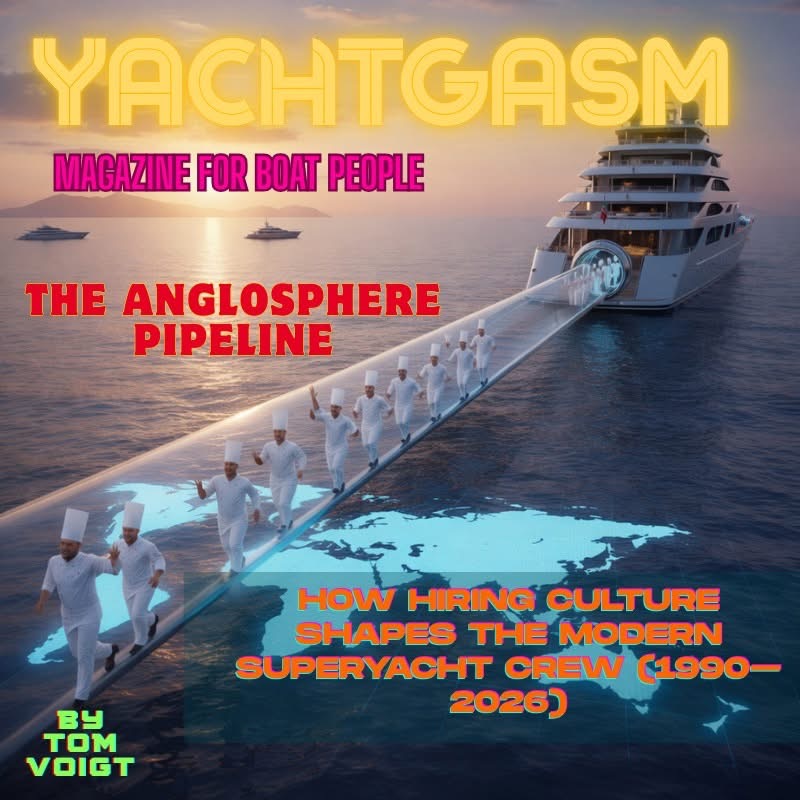
by Chef Tom Voigt. #26/0023.
The Anglosphere Pipeline
How Hiring Culture Shapes the Modern Superyacht Crew (1990–2026)
A factual review of fleet growth, labour structure and nationality dynamics in the modern yacht industry
The international superyacht industry has undergone a profound structural transformation over the past three decades. What was still a comparatively niche sector in the early 1990s has evolved into a globalised, highly professionalised industry employing tens of thousands of crew members across several thousand vessels.
With growth came complexity. With complexity came filtering mechanisms. And with filtering mechanisms came recurring debates about nationality, language and access to opportunity.
This report does not seek to accuse or dramatise. It seeks to clarify what can be factually supported, what can reasonably be inferred, and what remains anecdotal.
- Fleet Expansion and Structural Change (1990–2026)
The scale of the industry today is fundamentally different from that of the 1990s. According to technical industry data referenced by RINAUTIC, the global superyacht fleet reached approximately 5,092 vessels by the end of 2019, representing more than a sixfold increase compared with the mid-1980s baseline. This expansion reflects long-term growth rather than a short-lived bubble.
Post-pandemic momentum accelerated this trend further. BOAT International reported that the global superyacht order book reached historic highs in 2023, marking one of the strongest new-build cycles in the industry’s history. Although the order book has since stabilised, it remains elevated compared with pre-2020 levels.
With fleet expansion comes increased crew demand. Industry sources such as SuperyachtNews, citing estimates from The Superyacht Agency, suggest that the number of active superyacht crew globally lies in the range of 60,000 to 70,000 individuals, although precise figures remain difficult to establish due to rotation, relief crew and short-term contracts. It is important to emphasise that no centralised global census of yacht crew exists.
The absence of comprehensive statistical transparency is a structural characteristic of the industry and must be considered when analysing nationality representation.
- What We Actually Know About Crew Nationalities
There is no official longitudinal dataset documenting nationality composition of superyacht crew from 1990 to 2026. However, certain surveys provide insight into recurring patterns.
ISWAN – The Welfare of Superyacht Crew (2018)
The International Seafarers’ Welfare and Assistance Network (ISWAN) conducted a substantial survey of superyacht crew in 2018. Among the most represented nationalities within the respondent sample were British, American, South African, Australian and New Zealander crew members.
It is crucial to clarify that this survey does not represent the entire global workforce, nor does it claim to. However, it does indicate a visible and recurring presence of crew from English-speaking countries and South Africa within the active yacht community.
ISWAN – YachtCrewHelp Annual Review (2022)
In ISWAN’s 2022 YachtCrewHelp report, which analyses usage of its confidential helpline service, 27.2% of identified nationalities among service users were British, while just over 10% were South African. Crew from at least 42 nationalities accessed the service.
Again, this is not a workforce census. It measures helpline engagement rather than total employment distribution. Nevertheless, it confirms that British and South African crew are highly visible and engaged within the yacht ecosystem.
Industry Estimates Concerning South African Crew
Several industry publications, including reporting referenced by Marine Industry News in connection with Superyacht Cape Town, have cited estimates suggesting that South African nationals may account for up to 30% of the global superyacht crew workforce. These figures are described as estimates rather than verified statistical totals, and should be treated accordingly. They reflect recurring industry perception rather than audited demographic data.
- Language as Structural Advantage
English has become the operational language aboard most internationally active superyachts. This development is not ideological but practical. Charter operations, multinational guest groups, regulatory documentation and global mobility all favour English as the default working language.
In practical terms, this reality creates an advantage for native or near-native English speakers during recruitment processes. Communication reliability under pressure is a legitimate operational concern for captains and management companies. When shortlisting candidates, recruiters frequently prioritise linguistic certainty.
This structural factor does not require explicit discrimination to generate unequal outcomes. It operates as a functional filter.
- Visa Access and Passport Mobility
Another documented mechanism influencing recruitment decisions is passport strength and visa flexibility. Interviews and analyses referenced in maritime academic work, including studies published via Theseus (Finnish maritime academic repository), highlight that owner preferences, visa requirements and ease of international travel can influence nationality selection.
Crew members holding passports that allow smoother access to the United States, Schengen Area or Caribbean regions may be perceived as administratively less complex hires. In a fast-moving charter environment, operational efficiency frequently outweighs philosophical neutrality.
This dynamic again reflects structural pragmatism rather than overt bias. However, its outcome can resemble nationality preference.
- Recruitment Agencies and Shortlisting Practices
Modern superyacht recruitment is heavily agency-driven. Compared to the 1990s, when dock-walking and direct captain hiring were more common, today’s system relies on databases, CV filtering and curated shortlists.
Industry platforms such as YPI CREW, cited via coverage in Yachting Pages, have openly acknowledged that qualified crew may occasionally be overlooked due to nationality-based preferences expressed by owners or management. The terminology used within the industry often refers to “owner preference,” “cultural fit,” or “communication standards.”
These phrases are not inherently discriminatory. However, they can function as soft filters in candidate selection.
The process is rarely malicious. It is often risk-averse.
Captains and heads of department tend to hire from networks they trust. Once a national cluster establishes itself within a role segment, referrals frequently circulate within that same network. This network replication effect is observable across multiple nationalities, not exclusively among South Africans, Britons or Australians.
- The French Riviera Paradox
A frequently raised question concerns the apparent underrepresentation of French yacht chefs in yachts based in Antibes, Nice or Monaco.
Geographic location does not automatically determine crew nationality. Many yachts home-ported in Southern France are flagged elsewhere, owned by non-French principals and operated under English-speaking command structures. Job advertisements for Antibes-based roles frequently list fluent English as mandatory, with French described as beneficial but not essential.
This does not demonstrate systematic exclusion of French professionals. However, it illustrates that local culinary heritage does not necessarily translate into hiring dominance.
The Riviera is geographically French. Operationally, it is international.
- Then and Now: 1990 Compared to 2026
In the 1990s, the industry was smaller, less standardised and less database-driven. Hiring often occurred through direct reputation, maritime background or personal introduction. Crews were smaller, and formalised recruitment agencies were less dominant.
By 2026, the sector operates with:
- significantly larger vessels and crews
- increased charter turnover
- greater owner influence in hiring decisions
- formal recruitment databases and digital shortlisting
- globalised career mobility
Professionalisation has improved efficiency, safety and service standards. At the same time, it has institutionalised filtering systems that were previously informal.
Efficiency and homogeneity often travel together.
- Is There Evidence of Systematic Nationality Discrimination?
There is no comprehensive dataset proving that a single nationality dominates or controls the industry. However, there is documented acknowledgement that nationality can influence hiring decisions in certain contexts, as reflected in recruiter commentary and survey findings.
The distinction is important.
Systemic mechanisms such as language dominance, visa convenience and network replication can produce patterns without requiring coordinated exclusion.
The industry’s international identity remains genuine. Yet international does not necessarily mean proportionally representative.
Conclusion
Between 1990 and 2026, the superyacht industry expanded dramatically in fleet size, crew demand and operational complexity. Surveys from ISWAN demonstrate a recurring visibility of British, South African and other English-speaking nationalities within crew populations, while industry commentary acknowledges that nationality can influence hiring outcomes in certain circumstances.
Structural factors—language, passports, owner preferences and agency-driven recruitment—collectively shape workforce composition. These mechanisms are practical, sometimes commercially justified, and rarely malicious. Nevertheless, they create observable patterns.
The industry prides itself on being global.
It is indeed global in geography.
Whether it is equally global in opportunity remains a question shaped less by intent and more by structure.
And in a sector built on precision, structure tends to matter.