A Day in the Life of a Dockwalker

#26/0156. With Courtesy of Erica Lay. Erica Lay is owner of EL CREW International Yacht Crew Agency http://www.elcrewco.com/ erica@elcrewco.com

A Day in the Life of a Dockwalker: The Reality of Starting Out in Yachting

By Erica Lay, Superyacht Crew Agent and Author of Superyacht Life: How to Start, Succeed, & Stay Sane. Out now on Amazon.

Alarm goes off at 6am. Not because you’re starting work, but because you’re trying to look like someone who already has a job.

Welcome to life as green crew in Palma.

Starting out in yachting has always required a mix of determination, optimism and a decent pair of comfortable shoes. Dockwalking might sound old-school, but in 2026 it’s still one of the fastest ways to get your face seen and your name remembered, especially when you’re new to the industry.

The Morning Routine

A typical day starts early. CV printed, outfit pressed, hair tied back, shoes clean enough to walk onboard without raising eyebrows. Coffee helps. Confidence helps more.

Most green crew begin around the marinas where yachts are active. The goal isn’t to storm down the dock like you own the place, it’s to be respectful, observant and professional. Look for signs of activity, crew working on deck, or someone already mid-washdown who might need an extra pair of hands.

And yes, you will feel awkward at first. Everyone does.

Knock, Smile, Repeat

Dockwalking is essentially a professional version of door-knocking. You ring the bell, introduce yourself politely, and ask if they’re looking for dayworkers. Sometimes you’ll be greeted warmly. Sometimes you’ll get a polite no. Occasionally you’ll get no answer at all.

That’s normal.

The trick is consistency. Ten boats in a morning might lead to nothing. The eleventh could be the one that remembers you when they need help that afternoon. First impressions stick, so keep it short, friendly and professional.

The Waiting Game

Between dockwalking rounds, most green crew gravitate towards crew cafés or training centres. This isn’t wasted time, it’s where the networking happens. Conversations start over coffee, someone mentions a last-minute vacancy, and suddenly you’re handing over your CV again.

Yachting runs heavily on word of mouth, especially at entry level. Showing up in person signals commitment in a way that online applications rarely can.

The Reality Check

What social media doesn’t always show is the uncertainty. Some days you’ll walk miles and hear nothing back. Some days you’ll get three calls at once and have to choose which opportunity to chase.

It can be frustrating. It can also be incredibly rewarding when that first daywork turns into a week, and that week becomes your first contract.

Green crew quickly learn that reliability matters more than perfection. Turning up early, listening carefully, and being willing to learn goes further than trying to look like you already know everything.

The Afternoon Reset

By mid-afternoon, many dockwalkers shift gears. Updating CVs, checking in with agents, or attending a short training session. The goal is to stay visible and proactive without burning out.

It’s easy to compare yourself to others, especially when someone lands a job quickly. Try not to. Everyone’s path into the industry looks slightly different, and persistence often matters more than timing.

The Unwritten Rules

There’s a rhythm to dockwalking that you pick up quickly. Don’t interrupt crew who are clearly busy with guests onboard. Don’t overshare your life story at the passerelle. And don’t forget that every interaction, even a quick hello, contributes to your reputation.

Yachting is smaller than it looks from the outside.

Why It Still Works

Despite the rise of online recruitment and social media, dockwalking remains part of the culture because it shows initiative. Captains and heads of department see dozens of CVs every week, but they remember the person who introduced themselves professionally and made a genuine effort. Daily. For weeks. 

It’s not about chasing yachts blindly. It’s about showing you’re ready to be part of the industry, not just watching it from afar.

Starting out isn’t always glamorous. There will be long days, sore feet and moments where you wonder if it’s worth it. But for many crew, that first morning on the dock is the beginning of a career that takes them further than they ever imagined.

And one day, you might be the one answering the bell.

#YachtingLife
#SuperyachtLife
#Dockwalking
#GreenCrew
#YachtCrew
#SuperyachtCrew
#CrewLife
#Daywork
#YachtJobs
#YachtingIndustry
#CrewRecruitment
#StewardessLife
#DeckhandLife
#PalmaDeMallorca
#PalmaYachting
#MarinaLife
#CrewNetwork
#EntryLevelYachting
#YachtCareer
#WorkOnYachts
#LuxuryYachting
#CrewAgent
#LifeAtSea
#YachtTraining
#YachtCrewLife
#FutureCrew
#Yachties
#YachtingCommunity
#SuperyachtJobs
#TheFlyingFish

Dedicated to Remo Maute

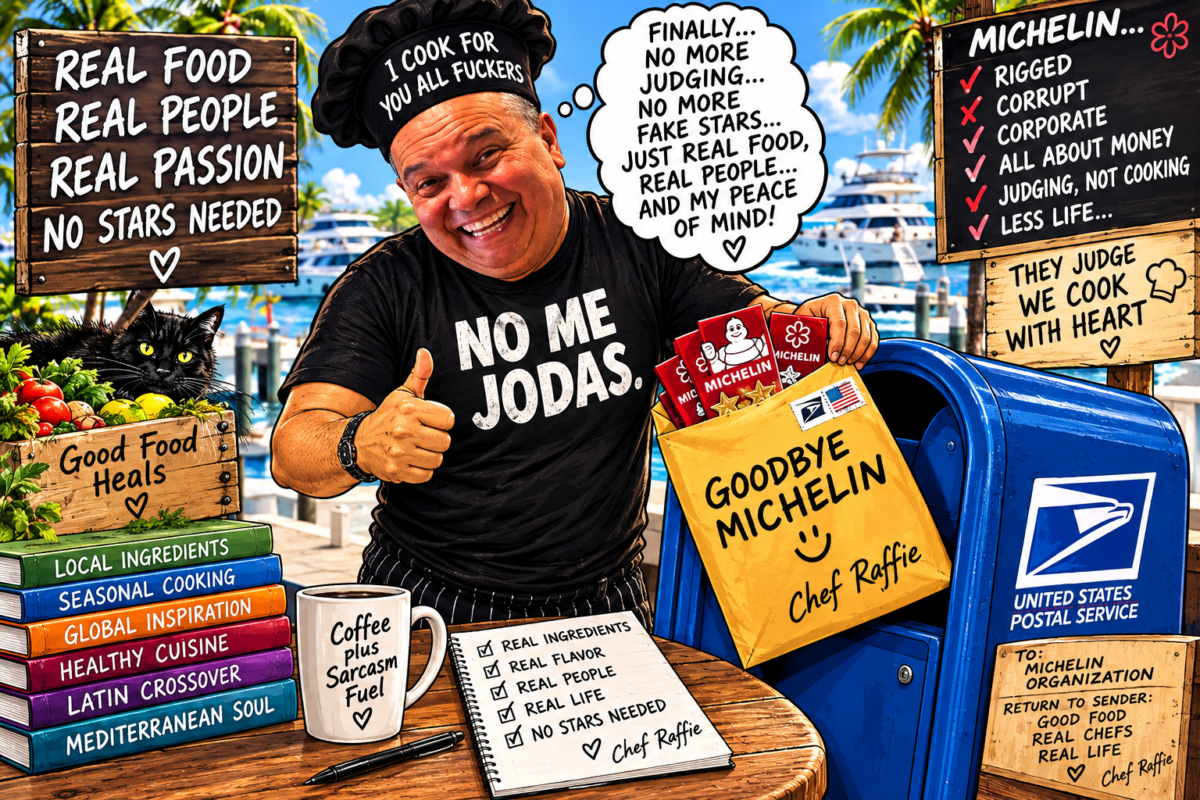
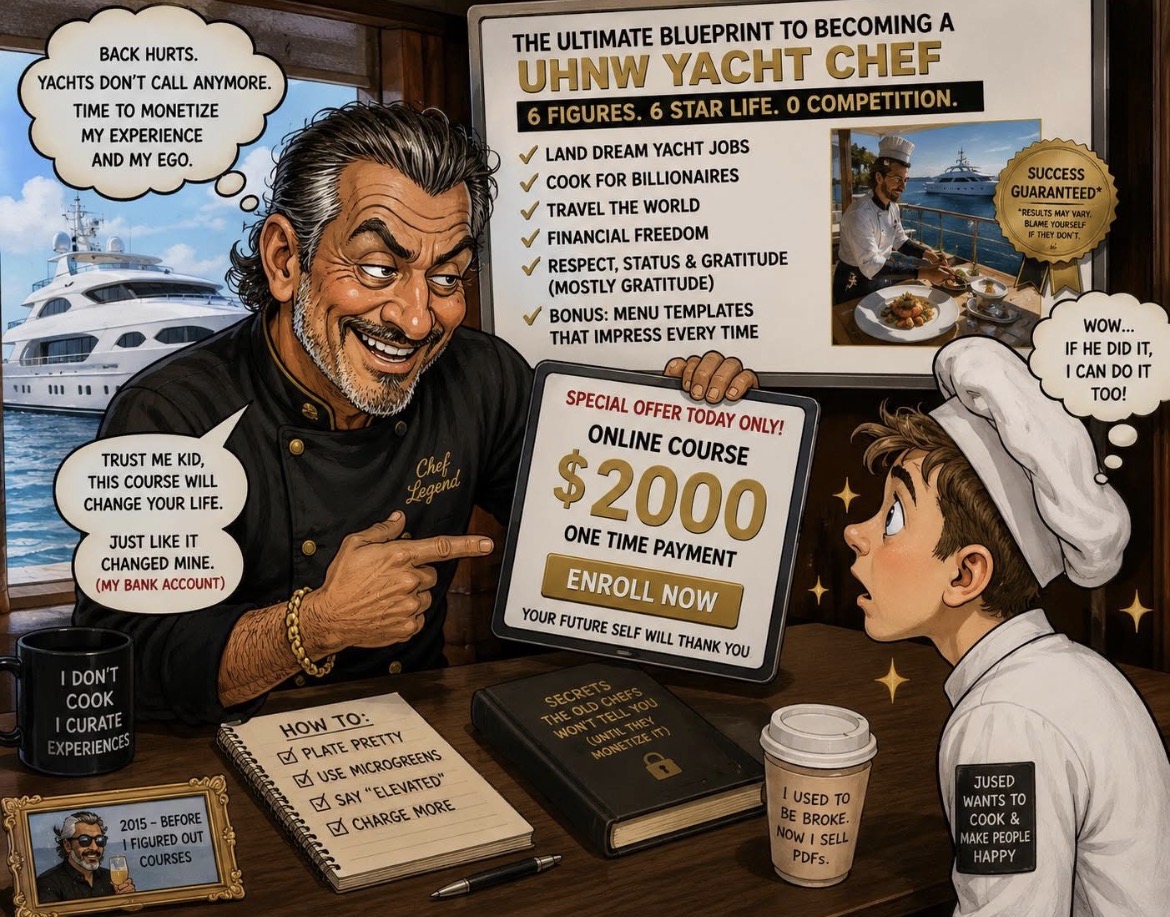
By Chef Raffie. #26/0137.

Dedicated to Remo Maute!

Dear Remo;
thank you for saying publicly what some of us have been trying to explain for years.

Now let me start with a public service announcement to the future chefs in the yachting industry! If it is too good to be true, it’s not true!

Somewhere along the way, social media convinced people that being a private chef for UHNW families is mostly sunlight, marble countertops, slow-motion olive oil pours, and filming yourself cutting chives while soft jazz or techno music plays in the background.

Meanwhile, in the real world, the actual professionals are too busy working 14-hour days, changing menus 17 times, managing allergies, last-minute guests, security protocols, impossible logistics, and learning the fine art of disappearing while somehow making everything run perfectly.

The irony is that the best private chefs in this world are usually the least visible ones.

Because if you truly understand discretion, trust, and the level of responsibility involved in these households… your first instinct is not to pull out your phone and become a lifestyle influencer.

And sadly, a very large percentage of people entering this industry today don’t yet understand the difference between “content creation” and actual service at the UHNW level.

Ah yes… the sacred final stage of the yachting lifecycle.

Some chefs, instead of quietly retiring into the sunset with dignity, suddenly discover their true calling — becoming “elite mentors” online the moment the charters stop calling.

One day they’re screaming at a broken dishwasher on a 42-meter with no dry storage…
and the next day they’re on Instagram selling a $2000 masterclass titled:

“Manifesting Your Dream Life as an Ultra High Net Worth Yacht Chef.”

One gets likes.
The other gets trusted.

Big difference.

Thank you again, my friend, for bringing a little reality back into the conversation without the garnish.

So You Want a Job in Yachting

#26/0134. With Courtesy of Erica Lay. Erica Lay is owner of EL CREW International Yacht Crew Agency http://www.elcrewco.com/ erica@elcrewco.com

So You Want a Job in Yachting? Here’s Where to Start

By Erica Lay, Superyacht Crew Agent and Author of Superyacht Life: How to Start, Succeed, & Stay Sane. Out now on Amazon.

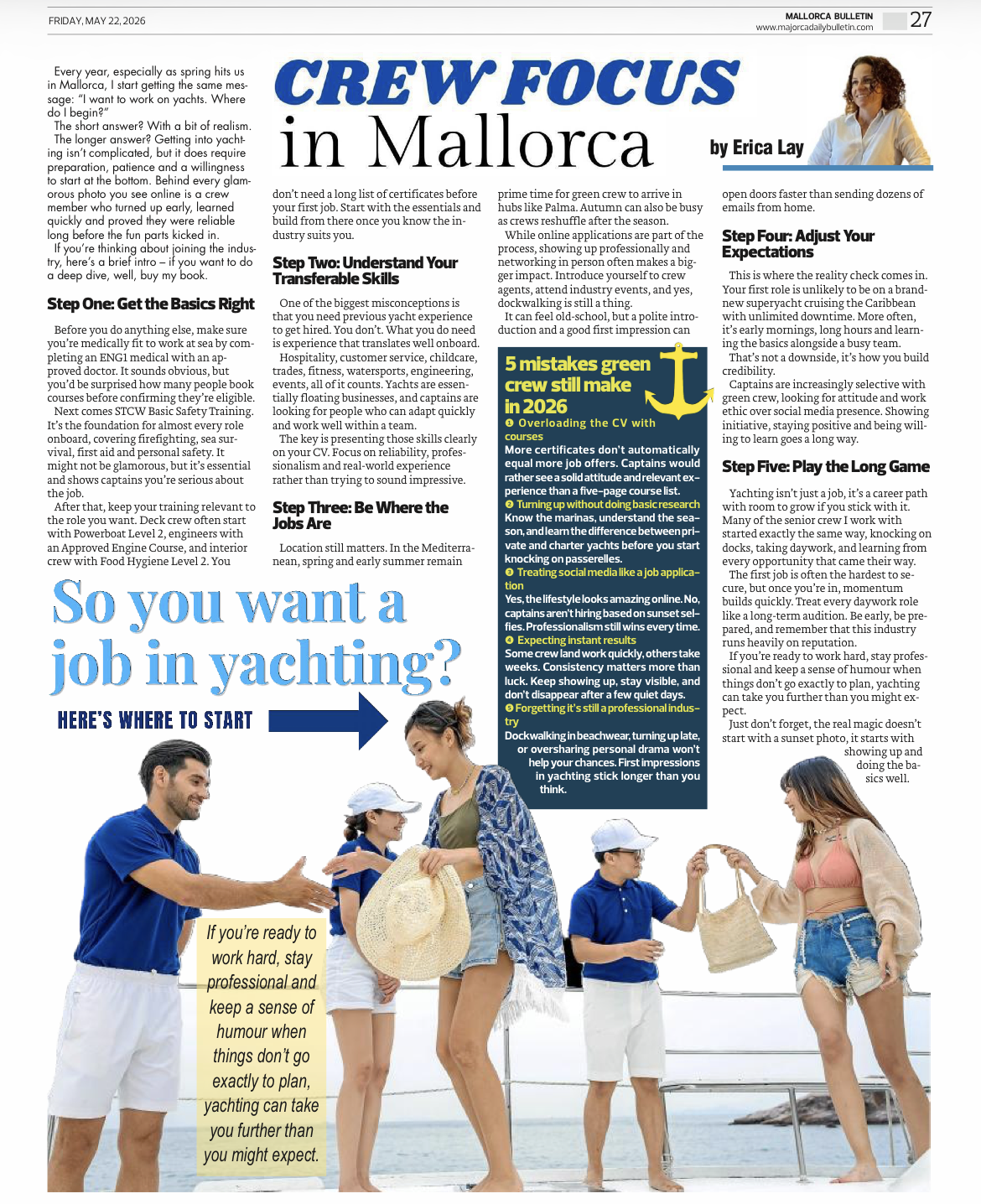
Every year, especially as spring hits us in Mallorca, I start getting the same message: “I want to work on yachts. Where do I begin?”

The short answer? With a bit of realism.

The longer answer? Getting into yachting isn’t complicated, but it does require preparation, patience and a willingness to start at the bottom. Behind every glamorous photo you see online is a crew member who turned up early, learned quickly and proved they were reliable long before the fun parts kicked in.

If you’re thinking about joining the industry, here’s a brief intro – if you want to do a deep dive, well, buy my book. 

Step One: Get the Basics Right

Before you do anything else, make sure you’re medically fit to work at sea by completing an ENG1 medical with an approved doctor. It sounds obvious, but you’d be surprised how many people book courses before confirming they’re eligible.

Next comes STCW Basic Safety Training. It’s the foundation for almost every role onboard, covering firefighting, sea survival, first aid and personal safety. It might not be glamorous, but it’s essential and shows captains you’re serious about the job.

After that, keep your training relevant to the role you want. Deck crew often start with Powerboat Level 2, engineers with an Approved Engine Course, and interior crew with Food Hygiene Level 2. You don’t need a long list of certificates before your first job. Start with the essentials and build from there once you know the industry suits you.

Step Two: Understand Your Transferable Skills

One of the biggest misconceptions is that you need previous yacht experience to get hired. You don’t. What you do need is experience that translates well onboard.

Hospitality, customer service, childcare, trades, fitness, watersports, engineering, events, all of it counts. Yachts are essentially floating businesses, and captains are looking for people who can adapt quickly and work well within a team.

The key is presenting those skills clearly on your CV. Focus on reliability, professionalism and real-world experience rather than trying to sound impressive.

Step Three: Be Where the Jobs Are

Location still matters. In the Mediterranean, spring and early summer remain prime time for green crew to arrive in hubs like Palma. Autumn can also be busy as crews reshuffle after the season.

While online applications are part of the process, showing up professionally and networking in person often makes a bigger impact. Introduce yourself to crew agents, attend industry events, and yes, dockwalking is still a thing.

It can feel old-school, but a polite introduction and a good first impression can open doors faster than sending dozens of emails from home.

Step Four: Adjust Your Expectations

This is where the reality check comes in. Your first role is unlikely to be on a brand-new superyacht cruising the Caribbean with unlimited downtime. More often, it’s early mornings, long hours and learning the basics alongside a busy team.

That’s not a downside, it’s how you build credibility.

Captains are increasingly selective with green crew, looking for attitude and work ethic over social media presence. Showing initiative, staying positive and being willing to learn goes a long way.

Step Five: Play the Long Game

Yachting isn’t just a job, it’s a career path with room to grow if you stick with it. Many of the senior crew I work with started exactly the same way, knocking on docks, taking daywork, and learning from every opportunity that came their way.

The first job is often the hardest to secure, but once you’re in, momentum builds quickly. Treat every daywork role like a long-term audition. Be early, be prepared, and remember that this industry runs heavily on reputation.

If you’re ready to work hard, stay professional and keep a sense of humour when things don’t go exactly to plan, yachting can take you further than you might expect.

Just don’t forget, the real magic doesn’t start with a sunset photo, it starts with showing up and doing the basics well.

SIDE PANEL 

5 Mistakes Green Crew Still Make in 2026

1. Overloading the CV with courses
More certificates don’t automatically equal more job offers. Captains would rather see a solid attitude and relevant experience than a five-page course list.

2. Turning up without doing basic research
Know the marinas, understand the season, and learn the difference between private and charter yachts before you start knocking on passerelles.

3. Treating social media like a job application
Yes, the lifestyle looks amazing online. No, captains aren’t hiring based on sunset selfies. Professionalism still wins every time.

4. Expecting instant results
Some crew land work quickly, others take weeks. Consistency matters more than luck. Keep showing up, stay visible, and don’t disappear after a few quiet days.

5. Forgetting it’s still a professional industry
Dockwalking in beachwear, turning up late, or oversharing personal drama won’t help your chances. First impressions in yachting stick longer than you think.

#Yachting #Superyacht #SuperyachtCrew #YachtCrew #YachtLife #YachtJobs #GreenCrew #YachtingCareers #YachtingLife #CrewLife #DeckCrew #InteriorCrew #YachtStewardess #Deckhand #STCW #ENG1 #Dockwalking #PalmaDeMallorca #MallorcaYachting #MedSeason #YachtingIndustry #SuperyachtLife #YachtingTips #CrewAgent #NewToYachting #YachtingAdvice #TheFlyingFish

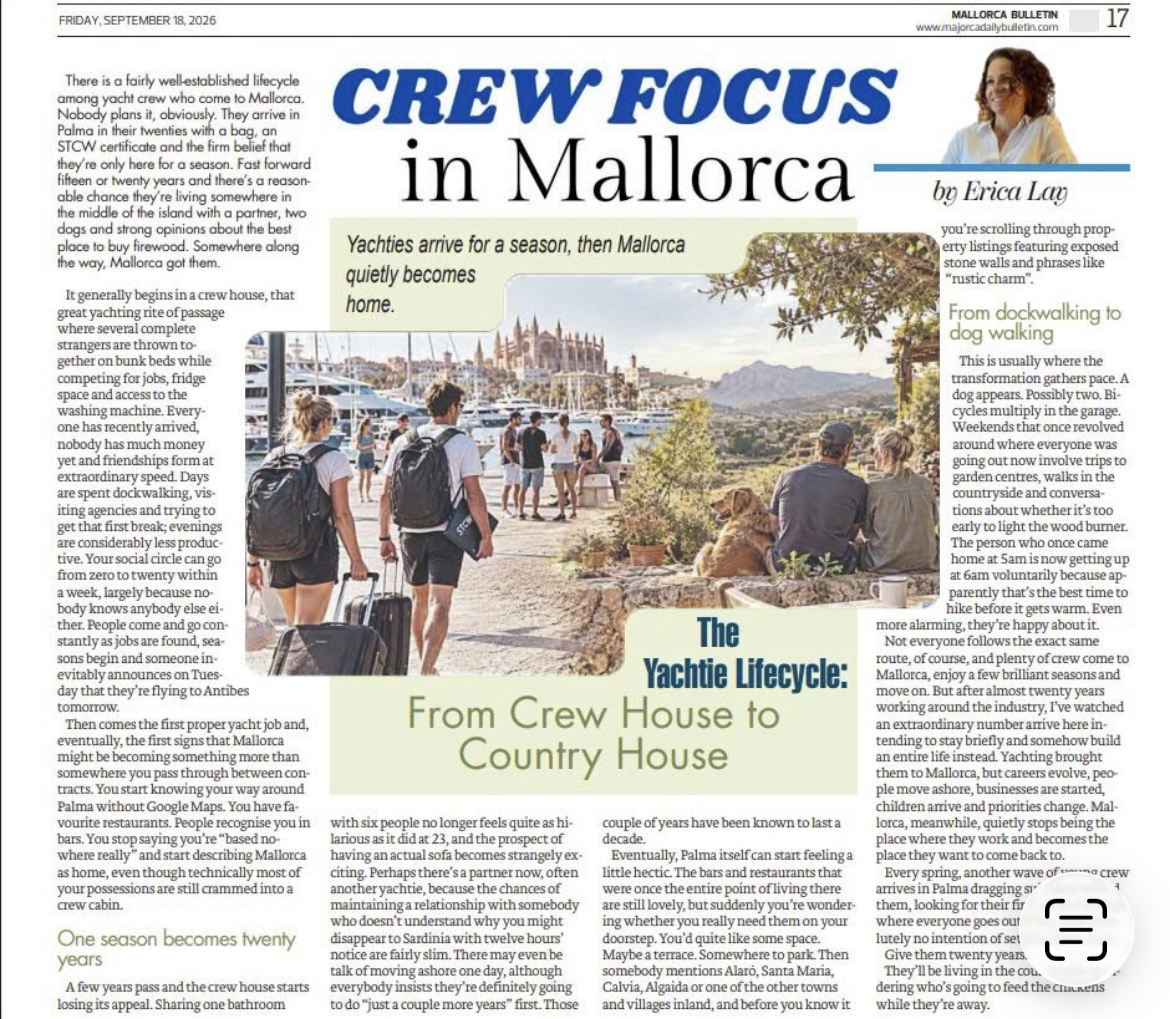
Why So Many Yacht Crew End Up Calling Mallorca Home

#26/0111. With Courtesy of Erica Lay. Erica Lay is owner of EL CREW International Yacht Crew Agency http://www.elcrewco.com/ erica@elcrewco.com

By Erica Lay, owner of EL CREW CO International Yacht Crew Agency and author of Superyacht Life: How to Start, Succeed, & Stay Sane.

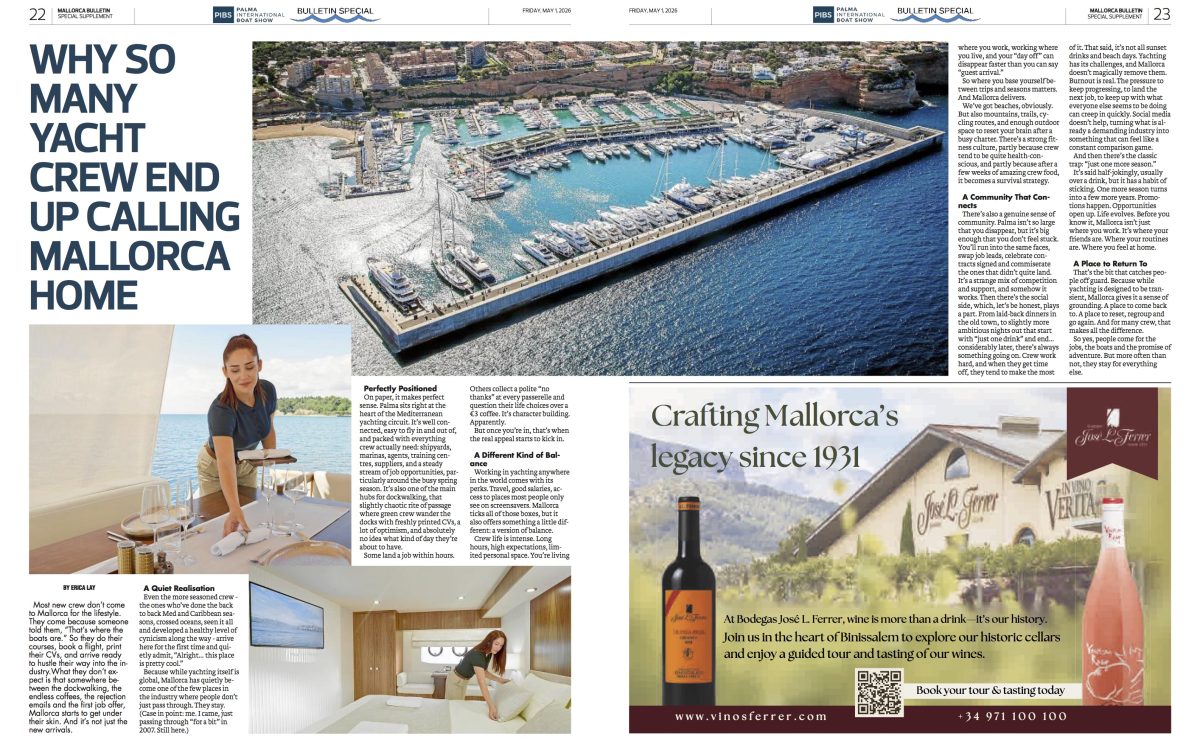
Most new crew don’t come to Mallorca for the lifestyle. They come because someone told them, “That’s where the boats are.” So they do their courses, book a flight, print their CVs, and arrive ready to hustle their way into the industry.

What they don’t expect is that somewhere between the dockwalking, the endless coffees, the rejection emails and the first job offer, Mallorca starts to get under their skin.

And it’s not just the new arrivals.

Even the more seasoned crew – the ones who’ve done the back to back Med and Caribbean seasons, crossed oceans, seen it all and developed a healthy level of cynicism along the way – arrive here for the first time and quietly admit, “Alright… this place is pretty cool.”

Because while yachting itself is global, Mallorca has quietly become one of the few places in the industry where people don’t just pass through. They stay. (Case in point: me. I came,just passing through “for a bit” in 2007. Still here.) 

On paper, it makes perfect sense. Palma sits right at the heart of the Mediterranean yachting circuit. It’s well connected, easy to fly in and out of, and packed with everything crew actually need: shipyards, marinas, agents, training centres, suppliers, and a steady stream of job opportunities, particularly around the busy spring season.

It’s also one of the main hubs for dockwalking, that slightly chaotic rite of passage where green crew wander the docks with freshly printed CVs, a lot of optimism, and absolutely no idea what kind of day they’re about to have.

Some land a job within hours. Others collect a polite “no thanks” at every passerelle and question their life choices over a €3 coffee. It’s character building. Apparently.

But once you’re in, that’s when the real appeal starts to kick in.

Working in yachting anywhere in the world comes with its perks. Travel, good salaries, access to places most people only see on screensavers. Mallorca ticks all of those boxes, but it also offers something a little different: a version of balance.

Crew life is intense. Long hours, high expectations, limited personal space. You’re living where you work, working where you live, and your “day off” can disappear faster than you can say “guest arrival.”

So where you base yourself between trips and seasonsmatters. And Mallorca delivers.

We’ve got beaches, obviously. But also mountains, trails, cycling routes, and enough outdoor space to reset your brain after a busy charter. There’s a strong fitness culture, partly because crew tend to be quite health-conscious, and partly because after a few weeks of amazing crew food, it becomes a survival strategy.

There’s also a genuine sense of community. Palma isn’t so large that you disappear, but it’s big enough that you don’t feel stuck. You’ll run into the same faces, swap job leads, celebrate contracts signed and commiserate the ones that didn’t quite land. It’s a strange mix of competition and support, and somehow it works.

Then there’s the social side, which, let’s be honest, plays a part. From laid-back dinners in the old town, to slightly more ambitious nights out that start with “just one drink” and end… considerably later, there’s always something going on. Crew work hard, and when they get time off, they tend to make the most of it.

That said, it’s not all sunset drinks and beach days. Yachting has its challenges, and Mallorca doesn’t magically remove them. Burnout is real. The pressure to keep progressing, to land the next job, to keep up with what everyone else seems to be doing can creep in quickly. Social media doesn’t help, turning what is already a demanding industry into something that can feel like a constant comparison game.

And then there’s the classic trap: “just one more season.”

It’s said half-jokingly, usually over a drink, but it has a habit of sticking. One more season turns into a few more years. Promotions happen. Opportunities open up. Life evolves.Before you know it, Mallorca isn’t just where you work. It’s where your friends are. Where your routines are. Where you feel at home.

That’s the bit that catches people off guard. Because while yachting is designed to be transient, Mallorca gives it a sense of grounding. A place to come back to. A place to reset, regroup and go again. And for many crew, that makes all the difference.

So yes, people come for the jobs, the boats and the promise of adventure. But more often than not, they stay for everything else.

Mallorca #Palma #PalmaDeMallorca #Yachting #Superyacht #YachtCrew #YachtLife #CrewLife #YachtingLifestyle #Dockwalking #GreenCrew #YachtingCommunity #TheFlyingFish #YachtingCulture #MediterraneanYachting #MedSeason #Balearics #IslasBaleares #YachtingMallorca #PalmaLife #SuperyachtCrew #SuperyachtLife #ELCREWCO #YachtingCareers #CrewLifeMallorca #YachtJobs #SantaCatalina #YachtingIndustry

The Real Backbone Of Mallorca

#26/0110. With Courtesy of Erica Lay. Erica Lay is owner of EL CREW International Yacht Crew Agency http://www.elcrewco.com/ erica@elcrewco.com.

The Real Backbone of Mallorca? It Floats.

By Erica Lay, owner of EL CREW CO International Yacht Crew Agency and author of Superyacht Life: How to Start, Succeed, & Stay Sane.

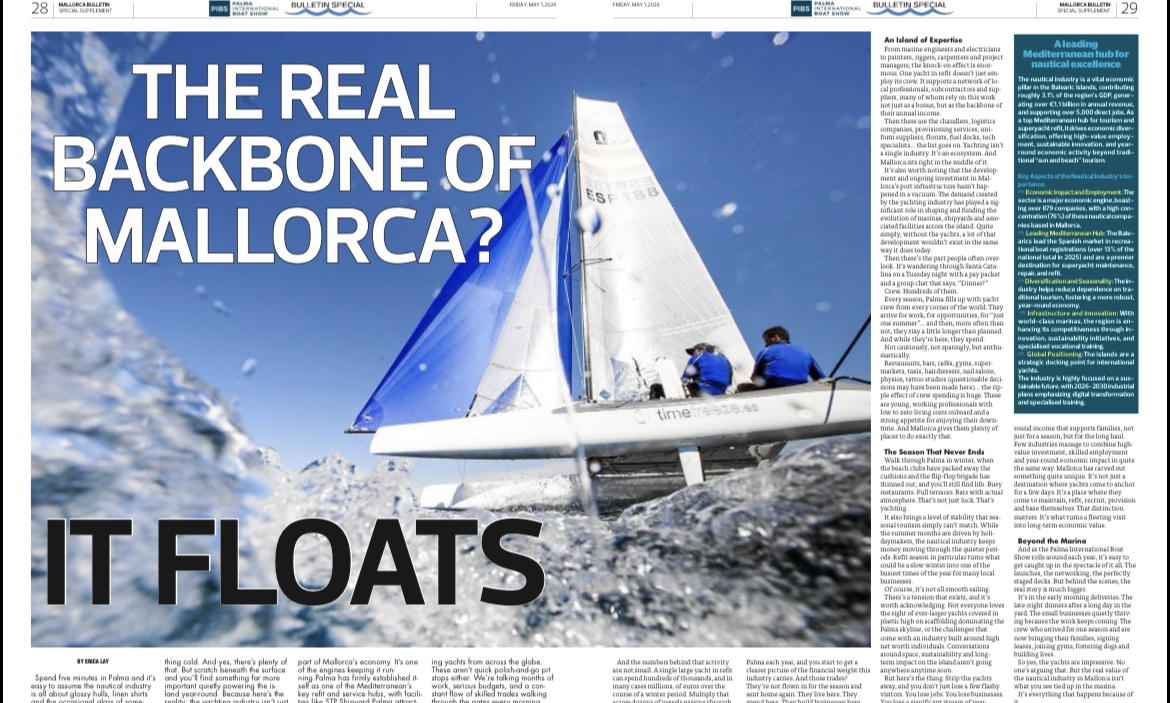
Spend five minutes in Palma and it’s easy to assume the nautical industry is all about glossy hulls, linen shirts and the occasional glass of something cold. And yes, there’s plenty of that. But scratch beneath the surface and you’ll find something far more important quietly powering the island year-round.

Because here’s the reality: the yachting industry isn’t just part of Mallorca’s economy. It’s one of the engines keeping it running.

Palma has firmly established itself as one of the Mediterranean’s key refit and service hubs, with facilities like STP Shipyard Palma attracting yachts from across the globe. These aren’t quick polish-and-go pit stops either. We’re talking months of work, serious budgets, and a constant flow of skilled trades walking through the gates every morning.

And the numbers behind that activity are not small. A single large yacht in refit can spend hundreds of thousands, and in many cases millions, of euros over the course of a winter period. Multiply that across dozens of vessels passing through Palma each year, and you start to get a clearer picture of the financial weight this industry carries.

And those trades? They’re not flown in for the season and sent home again. They live here. They spend here. They build businesses here.

From marine engineers and electricians to painters, riggers, carpenters and project managers, the knock-on effect is enormous. One yacht in refit doesn’t just employ its crew. It supports a network of local professionals, subcontractors and suppliers, many of whom rely on this work not just as a bonus, but as the backbone of their annual income.

Then there are the chandlers, logistics companies, provisioning services, uniform suppliers, florists, fuel docks, tech specialists… the list goes on. Yachting isn’t a single industry. It’s an ecosystem. And Mallorca sits right in the middle of it.

It’s also worth noting that the development and ongoing investment in Mallorca’s port infrastructure hasn’t happened in a vacuum. The demand created by the yachting industry has played a significant role in shaping and funding the evolution of marinas, shipyards and associated facilities across the island. Quite simply, without the yachts, a lot of that development wouldn’t exist in the same way it does today.

Then there’s the part people often overlook. It’s wandering through Santa Catalina on a Tuesday night with a pay packet and a group chat that says, “Dinner?”

Crew. Hundreds of them.

Every season, Palma fills up with yacht crew from every corner of the world. They arrive for work, for opportunities, for “just one summer”… and then, more often than not, they stay a little longer than planned. And while they’re here, they spend.

Not cautiously, not sparingly, but enthusiastically.

Restaurants, bars, cafés, gyms, supermarkets, taxis, hairdressers, nail salons, physios, tattoo studios (questionable decisions may have been made here)… the ripple effect of crew spending is huge. These are young, working professionals with low to zero living costs onboard and a strong appetite for enjoying their downtime. And Mallorca gives them plenty of places to do exactly that.

Walk through Palma in winter, when the beach clubs have packed away the cushions and the flip-flop brigade has thinned out, and you’ll still find life. Busy restaurants. Full terraces. Bars with actual atmosphere. That’s not just luck. That’s yachting.

It also brings a level of stability that seasonal tourism simply can’t match. While the summer months are driven by holidaymakers, the nautical industry keeps money moving through the quieter periods. Refit season in particular turns what could be a slow winter into one of the busiest times of the year for many local businesses.

Of course, it’s not all smooth sailing.

There’s a tension that exists, and it’s worth acknowledging. Not everyone loves the sight of ever-larger yachts covered in plastic high on scaffolding dominating the Palma skyline, or the challenges that come with an industry built around high net worth individuals. Conversations around space, sustainability and long-term impact on the island aren’t going anywhere anytime soon.

But here’s the thing. Strip the yachts away, and you don’t just lose a few flashy visitors. You lose jobs. You lose businesses. You lose a significant stream of year-round income that supports families, not just for a season, but for the long haul.

Few industries manage to combine high-value investment, skilled employment and year-round economic impact in quite the same way.

Mallorca has carved out something quite unique. It’s not just a destination where yachts come to anchor for a few days. It’s a place where they come to maintain, refit, recruit, provision and base themselves. That distinction matters. It’s what turns a fleeting visit into long-term economic value.

And as the Palma International Boat Show rolls around each year, it’s easy to get caught up in the spectacle of it all. The launches, the networking, the perfectly staged decks. But behind the scenes, the real story is much bigger.

It’s in the early morning deliveries. The late-night dinners after a long day in the yard. The small businesses quietly thriving because the work keeps coming. The crew who arrived for one season and are now bringing their families, signing leases, joining gyms, fostering dogs and building lives.

So yes, the yachts are impressive. No one’s arguing that.

But the real value of the nautical industry in Mallorca isn’t what you see tied up in the marina.

It’s everything that happens because of it.

Mallorca #Palma #PalmaDeMallorca #Yachting #Superyacht #SuperyachtIndustry #YachtCrew #YachtLife #YachtRefit #STPPalma #PalmaShipyard #PalmaBoatShow #PIBS2026 #MediterraneanYachting #YachtingCulture #TheFlyingFish #YachtingCommunity #Balearics #IslasBaleares #YachtIndustry #CrewLife #YachtingLifestyle #MarineIndustry #RefitSeason #SantaCatalina #YachtingMallorca #ECREWCO #SuperyachtLife

Breathing Techniques for Stress


#26/0101. Michael Lowman writes about working under pressure in yachting environments and the practical application of breathwork and awareness in day-to-day operations.
You can find him www.breathofchang.com

Breathing Techniques for Stress: Staying Calm Under Pressure on Deck

Stand By — The Moment Before It Kicks Off

You’ve heard it before:
“Stand by the anchor.”
“Stand by to stand by.”

Glasses on, cutting through the glare, I stared out at my office. For all the challenges, it had its perks.

I was on deck as the engineer came up, huffing, already irritated he’d been pulled off what he saw as more important work than hauling anchor.

We stood waiting for the command.

Tick tock. Tick tock.
Time, always on the boss’s terms.

You Can Feel It Before Anything Happens

I glanced over at him. You could feel it building.

Tight shoulders.
Short breath.
That low-level frustration that can flip quickly if something goes wrong.

Anyone who’s worked on deck knows this feeling. The job hasn’t even started yet, but the pressure is already there.

What’s Actually Happening in Your Body

In those moments, your body is already switching gears.

  • Breathing gets shorter and higher in the chest
  • Heart rate increases
  • You move closer to a fight-or-flight state

It’s automatic. No one teaches you this, but it drives how you react.

And on a yacht, reactions matter.

A Small Adjustment That Changes Everything

I didn’t say much. Just a small gesture:

Slow it down.
Breathe into the belly.

It’s simple, but it works:

  • Inhale through the nose
  • Let the breath drop into your stomach
  • Slow the exhale

Within a minute or two, things settle.

Not because the situation changed, but because your state did.

Why This Matters on Deck

Pressure isn’t going anywhere in this industry.

Tight turnarounds.
Demanding owners.
Long hours.
High expectations.

You can’t remove that.

But you can create a bit of space between what happensand how you respond.

And that space is often the difference between:

  • staying composed
  • or escalating a situation that doesn’t need it

The Tough Crowd

If I’m honest, he was the last person I expected to take anything from it.

Proper tough crowd.

Skeptical.
Not interested in anything that sounded like “breathing techniques” or anything remotely close to yoga.

Fair enough.

Most people in this industry aren’t looking for that. 

The Quiet Win

At the end of the season, he came up to me and said:

“Thank you… that breathing thing you showed me, it helped me a lot.”

No big moment. No speech.

Just that.

And that was enough.

Because it wasn’t about convincing him.

It was about giving him something he could use, when he needed it.

Final Thought

You don’t need to buy into anything.

But if you can catch yourself in those moments, when your breath shortens, when tension rises, and slow it down, even slightly…

You give yourself a chance.

And at SEA, that can make all the difference.

Spring in Mallorca

With Courtesy of Erica Lay & The Mallorca Bulletin. #26/0063. Erica Lay is owner of EL CREW International Yacht Crew.

Spring in Mallorca doesn’t ease in gently when it comes to the Superyacht Industry. It kicks the door down.

One minute Palma’s shipyards are in full winter mode – and that’s not quiet, despite what anyone who doesn’t work in yachting might think. It’s a full-blown hive of activity. Enormous yachts up on the hard covered in scaffolding and plastic wrap getting paint jobs, grinders screaming, teak decks being re-caulked, engines being taken to bits, generators getting replaced, new rigs going in, new sails arriving, interior refits, galley upgrades… contractors and crew juggling seventeen jobs at once and surviving almost entirely on caffeine and mild panic.

Then the sun comes out… and everything speeds up.

Boats that have been cocooned for months are suddenly unwrapped like very expensive Christmas presents. Fresh paint gleaming, stainless polished to within an inch of its life, teak looking suspiciously perfect. 

Meanwhile, all the yachts which were winterised and kept quietly ticking over in the marinas start to wake up, like Sleeping Beauty after a particularly splendid slumber. 

For a brief, glorious window, everything seems pristine.

Give it a week.

Because as the yachts emerge from their winter chrysalises… so do the crew.

Palma in spring turns into a live-action job hunt, and it can be savage. Dockwalkers everywhere. CVs clutched like golden tickets, trying to look casual while very much not being casual. There’s always one in full whites (ambitious), one wildly overdressed for 8am, and one who has clearly underestimated just how much walking is involved and is now rethinking their life choices and footwear somewhere between STP and Club de Mar.

The cafés fill up fast. You’ve got returning experienced crew swapping winter stories like they’ve come back from war, and green crew trying to decode what “just keep showing your face” actually means in practice, making one coffee last three hours. 

Meanwhile, onboard… Spring is when captains are having a quiet crisis.

That creeping realisation that recruitment for the looming summer Med season was meant to be sorted weeks ago has well and truly landed. Now it’s an inbox full of CVs, a couple of key gaps, and guests arriving far sooner than feels reasonable. Cue the frantic scrolling, the “we’ll just trial them and see” hires, and a sudden appreciation for anyone who can tie a decent fender knot without Googling it first. And that’s usually when I come into my own, as a superyacht recruiter of nearly twenty years, this is The Most Wonderful Time of The Year (yes ok, I sang that). Captains? Call me. Let me take the strain. 

Whilst the bridge desk floods under the captain’s tears of frustration, down on deck, it’s controlled chaos.

The job list is endless, the pressure is on, and just as someone finally gets stuck into something important… another dockwalker appears. And then, inevitably, there’s Gary.

Many yachts have a Gary. Lovely guy. Solid worker. Absolutely incapable of just taking a CV from a dockwalker and moving on. What should be a five-second interaction turns into a full breakdown of Gary’s “journey,” his three previous boats, a full CV review, and a story that definitely does not need to be told right now.

Somewhere behind him, the deck team is mid caulking, someone’s holding a power tool, a can of varnish got knocked over and Gary’s still chatting. This is when the First Materesorts to placing a basket on the passerelle labelled “CVs here please” alongside a note that might as well read:  Please do not engage Gary. He has no self-control and we are on a deadline.

And then – just as the mayhem peaks – along comes the Palma International Boat Show.

This is it. The unofficial but very real start of the Mediterranean season. Palma sharpens up, the docks fill with immaculate yachts, red trousers, bare ankles, and suddenly everyone is exactly where they’re meant to be. Meetings, deals, reunions, a little bit of gossip… and a lot of people pretending they’re not already slightly exhausted.

From here, it’s game on. Boats leave, ready or not, charters begin, and Mallorca slides effortlessly into full summer mode.

But this bit – this slightly frantic, sun-soaked, slightly unhinged build-up known as Spring – this is where the magic is.

It’s hopeful. It’s chaotic. It’s full of opportunity.

And somehow, despite the panic, the pressure, and the Garys… it all comes together.

Just in time.

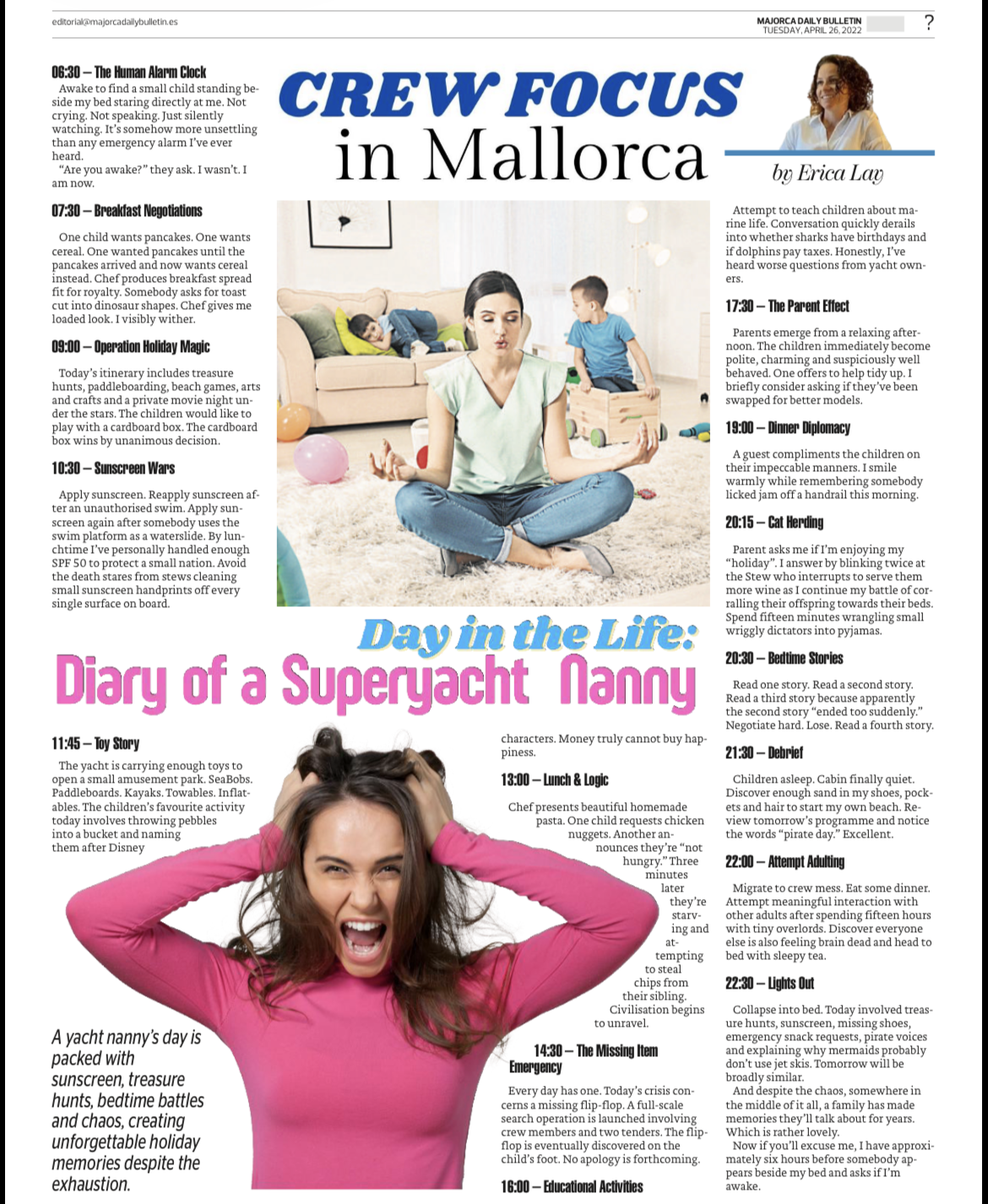
Day in the Life

With Courtesy of Erica Lay & The Mallorca Bulletin. #26/0056. Erica Lay is owner of EL CREW International Yacht Crew.

Day in the Life: Confessions of a Superyacht Recruiter

By Erica Lay, owner of EL CREW CO Superyacht Recruitment agency and author of Superyacht Life: How to Start, Succeed, & Stay Sane – available now on Amazon.

It seems the Day in the Life series was quite well received and I have been asked for more – mostly from the members of the yachting community who operate shore based and behind the scenes… so stay tuned for more! Today? Well today I’m giving you a sneaky little peek into the routine of a recruiter. Which I guess I know a fair bit about… 

06:00 – Coffee & Existential Dread
The phone pings before the kettle’s even boiled. A captain in the Caribbean wants a new deckhand-slash-engineer-slash-chef-slash-stew “who can drive a tender, fix the aircon, cook a steak, and preferably has a golden retriever’s temperament.” I check the time zone. It’s 01:00 his time. Either the aircon’s broken again, or he’s having a breakdown. Possibly both.

07:00 – Inbox Roulette
Enter office clutching bucket of coffee with both hands. Power up computer. 187 new emails. Half are crew applying for roles that don’t exist, a quarter are clients who “urgently need” a crew member (but haven’t decided what salary, start date, or what qualification/experience they need yet), and the rest are out-of-office replies from people who will neverreturn. I start inhaling caffeine. Lots of it.

08:30 – CV Triage
Scroll through a stack of new CVs. Spot three with no surnames, one with “manifesting a deckhand role” as the career objective, and a particularly strong contender whose email address is partygirlforever@something.com. Delete. Immediately. Somewhere out there, a genuinely great candidate has formatted their CV in Comic Sans and I can feel it.

09:30 – Captain Call No.1
He wants a stew “who can also mix a decent margarita. For me.” I nod. Service skills, cocktail game, emotional support human… got it. Another perfectly normal Tuesday.

10:45 – Crisis Management
One chief stew calls in tears because her new hire (not through me) has ghosted her mid-season. Another just found out their new deckhand can’t swim. Yes, really. Also, no, not hired through me. I send consoling words, then immediately update my database: “DOES NOT SWIM.” Add extra bold.

12:30 – Lunch Break (ish)
Attempt to eat a sandwich while proofreading a CV where someone claims to have “fluent” French. In reality, they once ordered a croissant unaided. Decide it’s easier to skip lunch than sanity.

14:00 – Reference Roulette
Call a reference for a chef candidate. The voice on the other end sighs deeply and says, “How honest do you want me to be?” I brace myself. The next ten minutes are a mix of admiration, trauma, and recipes for revenge. I hang up and write: “Brilliant but volatile. Keep near fire extinguisher.”

15:30 – The Optimist Files
Interview a bright, eager greenie who says, “I don’t mind starting at the bottom.” I smile and gently explain that the bottom is wetter, smellier, and pays less than they think. They nod enthusiastically. Bless them.

17:00 – Client Debrief
Another captain calls. “Do you have anyone with strong deck experience, excellent service skills, advanced medical training, a master’s in psychology, and preferably doesn’t talk too much?” I tell him I’ll check Hogwarts.

18:30 – Database Deep Dive
Search for candidates. Lose three hours and half my will to live. Discover six people I placed years ago are now captains. Feel ancient.

20:00 – Wine & WhatsApps
Finally close the office door, pour a glass of rosé, and immediately get a WhatsApp from a junior stew asking if she should “follow up her follow-up.” I tell her to go for a walk, not a war.

22:00 – Midnight Manifestations
Lie in bed, mentally sorting candidates. Think about the ones who’ve made it, the ones who quit, and the ones still trying. Remember why I love this job. Because somewhere out there, the right crew will find the right boat. And when they do, it’s magic.

Then my phone pings. It’s the captain from earlier. He’s changed the job spec. Again.

The Silent Role of a Chef on Board

26/0051. By Chef Grecia Vargas.

The Silent Role of a Chef On Board: Who Takes Care of Those Who Care?

By Grecia Vargas

Reflections from the galley on the invisible care that sustains life on board a superyacht.

Dear industry,

I write this with genuine affection.

To acknowledge what this world has given me — the moments, the lessons, the intensity of it all.

Yachting is a fascinating environment.

You learn every day.

You live in confined spaces with people who were once strangers.

You maintain a positive mindset, no matter the circumstances.

You focus on detail.

You deliver high standards.

You work long hours.

You manage exhaustion.

Meals go out on time.

Everything stays clean and in order.

You remain professional.

You smile — even while cruising at 9.4 knots somewhere along the Mediterranean coast.

This is life on board.

A constant balance between attitude and professionalism.

In my case, that balance lives in the galley.

The role of a chef is central.

It is also exposed and demanding.

When guests come on board, expectations are clear:

Impeccable food.

Personalised.

Consistent.

No room for error.

But there is another side to this.

The crew.

They become your family for the season.

You live together.

Work together.

Push through together.

Their performance defines the experience.

Safety. Comfort. Enjoyment.

Everything depends on how well the team functions.

This is not a small responsibility.

The entire operation rests on one mission:

To create an unforgettable experience.

So the question is:

What does that success really depend on?

The answer is simple.

And often overlooked.

The human body has limits.

It needs sleep.

Food.

Recovery.

Stability.

Remove these, and performance breaks down.

Yet this profession demands the opposite.

Less sleep.

Interrupted rest.

Constant alertness.

Irregular meals.

No real rhythm.

Balance is fragile.

This is where the silent role of the chef begins.

During the peak of the season, there is no pause.

The crew must perform, every day.

Food becomes more than food.

It becomes fuel.

Recovery.

Support.

Through nutrition, the chef tries to compensate for the physical and mental strain placed on the team.

This often goes unnoticed.

Or is simply accepted as part of the job.

Something to deal with later.

“At the end of the season.”

But the reality is clear:

The galley does not just feed people.

The galley sustains the vessel.

Behind every smooth operation, there are people.

And those people need care.

Like an orchestra needs tuned instruments,

a crew needs to be maintained.

So the question returns:

Who takes care of those who care?

From the galley, the answer is quiet but constant.

Every meal is more than a task.

It is an act of support.

Three times a day, the crew is restored.

Energy is rebuilt.

Effort is acknowledged.

The galley becomes something close to sacred.

A place where wellbeing is sustained.

Because behind every perfect service,

every seamless voyage,

every unforgettable summer —

there is a human team making it happen.

And we, the chefs,

keep that system alive.

Quietly.

Plate by plate.

A Day in the Life: Paper Seas

With Courtesy of Erica Lay & The Mallorca Bulletin. #26/0046. Erica Lay is owner of EL CREW International Yacht Crew.

Day in the Life: Paper Seas — Diary of a Yacht Manager

By Erica Lay, Superyacht Crew Agent and Author of Superyacht Life: How to Start, Succeed, & Stay Sane. Out now on Amazon.

06:30 – Wake, Panic, Repeat
Wake up, check phone, immediately regret it. Twelve emails marked urgent arrived overnight. None actually are. One’s a crew member asking if his Wi-Fi allowance covers Netflix, another’s a captain forwarding a ten-page spreadsheet with no context, and one’s a yacht owner wondering if VAT is “optional.”

07:15 – Coffee & Crisis
Boot up the laptop. My inbox looks like a live crime scene. Crew contracts, insurance renewals, flag-state inspections, MLC compliance — all due yesterday. I make a list, then immediately lose it under another pile of lists.

08:00 – Budget Ballet
Open Excel. Discover someone spent €2,400 on “miscellaneous supplies.” I dig deeper. It’s candles. Scented. “For ambience,” says the purser. I breathe deeply and remind myself that prison orange isn’t my colour.

09:30 – Call with the Captain
He’s in the Med, I’m in Mallorca, and the Wi-Fi sounds like it’s routed through Mars. “Can you hear me?” he asks. No. I can’t. Not his words, not his excuses, not the sound of my youth slipping away. We discuss fuel budgets, provisioning, and crew turnover. He ends with, “Don’t worry, I’ll handle it.” That’s the most worrying sentence in the industry.

10:45 – Insurance Insanity
Broker calls. The owner wants to add “two experimental water toys” to the policy. They’re basically floating jet engines with Bluetooth. The insurer says no. The owner says “but Elon has one.” I email everyone a polite, professional “we’ll review coverage options,” while muttering, “we absolutely will not.”

12:00 – Lunch (Theoretically)
Half a sandwich, eaten one-handed while drafting an email about an incident report that somehow includes the phrase “slippery sushi.” A chef slipped, a guest laughed, and now there’s a medical bill in Monaco and a lawsuit in motion. Pass the antacids.

13:15 – Crew Drama Hour
Chief stew wants to fire her second stew for “bad vibes.” Engineer wants a pay rise “to reflect his value.” The captain wants to swap both out “for morale.” I suggest team-building. They suggest I walk the plank.

14:30 – Compliance Purgatory
Open an email from the flag state. It’s 14 pages of regulation updates written in legalese and spite. I forward it to the captain with the words, “For awareness,” which is yacht-management code for I’m not reading this either.

15:45 – Owner Check-In
Video call with the owner, who’s sitting on his terrace in the Bahamas, cocktail in hand. “How’s my boat?” he asks. I glance at the report showing an engine alarm, a damaged tender prop, and a missing deck cushion. “She’s in great shape,” I say. “Just routine maintenance.” He smiles. I smile. We both lie beautifully.

17:00 – Accountant Acrobatics
Reconcile invoices. One crew member submitted a €600 charge for “crew motivation.” It’s tequila. I question it. He says, “It lifted spirits.” Hard to argue with that logic. I approve half. For science.

18:30 – The Paper Tsunami
Finish one report, start another. Compliance logs, budget forecasts, meeting notes — all due before the next full moon, apparently. My screen time is obscene, my caffeine intake criminal, and my left eye has started twitching Morse code.

19:45 – The Twilight Texts
Just as I’m packing up, the captain messages: “Small issue with the generator, but we’re managing.” Small issuetranslates to “half the yacht is dark, and someone’s crying.” I pour another coffee and reopen the spreadsheet.

21:00 – False Finish Line
Close laptop. Feel fleeting satisfaction. Phone pings: WhatsApp group chat, “URGENT – FIRE DRILL REPORT.” The drill was today. They set off the wrong alarm. Again. One stew fainted, one guest complained, and the dog’s still traumatised. I reply with: “Noted, thank you,” which in yacht management language means “I hate all of you equally.”

22:15 – Rosé & Reflection
Pour wine. Sit on the balcony. Watch the lights of the marina twinkling below. Every yacht out there runs because someone like me spends their days neck-deep in spreadsheets, bureaucracy, and diplomacy. We’re the invisible life support of floating empires.

Then the phone pings again. Another “quick question.” There’s no such thing as quick. Not in this job.

I sigh, sip, and type back with my best fake cheer: “Of course – happy to help!”

Because in yacht management, you don’t retire – you just eventually merge with your inbox.