Hub – The Allure of the Open Sea

The Allure of the Open Sea: A Prelude to a History of Private Yachting by Gregory C. Y. Piatkowski. #24/0151.

October 12, 2024 · 5 min read


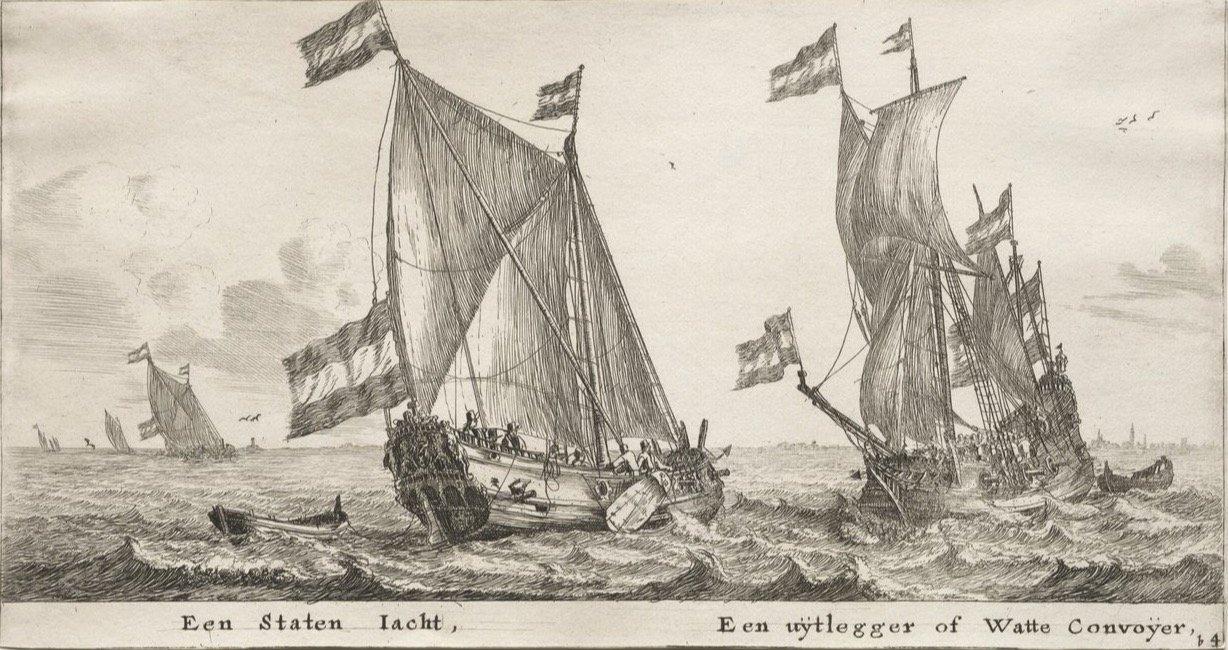
(Picture: Ships of Amsterdam: Dutch Admiralty Yacht. A Guard Ship.)

The Allure of the Open Sea: A Prelude to a History of Private Yachting

Private yachting is more than a pastime; it’s a lifestyle choice, a blend of adventure and exclusivity that offers freedom on the open water. At its heart, private yachting is the ownership or use of a vessel specifically for personal leisure rather than commercial or competitive purposes. It’s a realm where the practical meets the luxurious, where one can cruise at their own pace, far from the bustle of the shore, with a view that’s constantly changing.

Historically, private yachting emerged as a pursuit for the wealthy, those who sought both relaxation and status as they sailed along coastlines or crossed seas. Today, private yachting has expanded to encompass a diverse array of vessels, from compact sailing yachts to sprawling superyachts equipped with every imaginable amenity. While it once symbolized exclusivity and luxury, modern private yachting often reflects an appreciation for the environment, with owners exploring more sustainable ways to navigate the world’s oceans.

In essence, private yachting embodies a desire to escape, to explore, and to experience the world from a unique vantage point, one where the horizon is yours alone and the sea stretches endlessly before you.

In Hemingway’s words, the sea is “the last free place on earth.” Out there, away from the land and the noise, it’s just you and the horizon. That’s the allure that’s driven yachting from the start—a taste of true freedom, untamed and raw. Hemingway captured the soul of it: the sea is both a companion and a challenger, a place that reminds you that freedom isn’t found in comfort. It’s found when you’re willing to face the unknown, stripped down to your core.

This article is a first step—a pilot, if you will—into a series exploring the fascinating journey of private yachting from its origins to the present day. The history of private yachting isn’t just about boats; it’s about the people who embraced the open sea, driven by a sense of adventure, luxury, and freedom. This series will chart the evolution of private yachting across the centuries, beginning here with a broad look at its key milestones.

1600s: Dutch Beginnings and the Birth of the “Jacht”

Private yachting owes its start to the Dutch in the 17th century, who, amidst their Golden Age, crafted small, swift vessels called “jachts” to patrol waterways and transport goods. These boats quickly gained popularity among the Dutch elite, who saw in them the potential for leisure, not just utility. The Dutch merchant class and nobility began using these jachts for personal voyages, and with that, the first spark of private yachting was born.

1660: Charles II and the Spread of Yachting to England

In 1660, the Dutch presented England’s Charles II with a yacht named Mary, and the English king was captivated. This gift marked a pivotal moment, bringing yachting into the English court and spreading its allure to British nobility. Charles soon had more yachts built and started informal races on the Thames, solidifying yachting as a pursuit of leisure, not merely function.

1720: The First Yachting Club and Formalized Yachting

The Royal Cork Yacht Club, founded in 1720 in Ireland, became the world’s first yachting club, formalizing the sport with organized regattas. This institutionalization of yachting encouraged enthusiasts to gather, race, and discuss their passion. Yacht clubs spread throughout Europe, and yacht design began evolving with a focus on speed and maneuverability, laying the groundwork for competitive sailing as we know it.

1851: The America’s Cup and International Competition

The 1851 America’s Cup put yachting on an international stage when the American schooner America bested the British fleet. This historic race ignited a sense of rivalry that pushed yacht designs toward new heights of speed and efficiency. The America’s Cup remains a prestigious event, exemplifying yachting’s shift from leisurely cruising to high-stakes competition.

Late 1800s to Early 1900s: The Golden Age of Yachting

The late 19th century saw a surge in luxury yachting. Industrialists, royals, and socialites commissioned ever more lavish yachts, turning them into floating palaces complete with salons, dining rooms, and more. Steam-powered yachts allowed for extended journeys, further cementing yachting as a status symbol. During this golden era, private yachts became statements of wealth and a testament to the power of their owners. The golden era of classic sailing, with its elegant vessels and leisurely cruises, came to a crashing halt with the outbreak of World War I. Yachts that once glided along peaceful coastlines were suddenly pulled into the war effort, repurposed as patrol boats and hospital ships. Yacht builders traded teak and mahogany for steel and iron, their focus shifting from crafting beauty to building for battle. By the war’s end, the world had changed. That carefree elegance was a relic, and society was no longer in the mood for grandeur. The yachts of pre-war days became silent witnesses to a lost time, as people turned to rebuilding rather than indulging. Yachting would continue, of course, but it would emerge different—a symbol of the new world, shaped by both loss and resilience.

Post-WWII: Motor Yachts and Modern Materials

After World War II, advancements in materials like fiberglass and aluminum changed the game. These materials allowed for lighter, more durable yachts, and motor yachts surged in popularity, bringing unprecedented comfort and convenience. The 1950s and 60s saw the rise of the superyacht, with features like multiple decks, swimming pools, and lavish living spaces. Yachting had truly transformed into a lifestyle of luxury and freedom.

1970s-1980s: The Superyacht Craze

The 1970s and 80s witnessed a boom in superyachts, driven by the wealth of a new class of industrialists and moguls. Yacht builders like Feadship and Lürssen crafted massive vessels with cutting-edge technology, from satellite communications to computerized navigation systems. Superyachts became the ultimate symbol of affluence and the means for a select few to explore the world with unmatched comfort.

1990s-Present: Sustainability and New Trends

Today, yachting balances luxury with environmental consciousness. Innovations in hybrid propulsion systems, solar panels, and sustainable materials have redefined modern yacht design. Meanwhile, the trend toward expedition yachts has allowed owners to journey to remote, untouched places, blending exploration with eco-friendly practices. The spirit of yachting endures, with a new generation of yachts and yacht owners who prioritize sustainability while indulging in the age-old allure of the open sea.

What’s Next in This Series?

This pilot article sets the stage for a deeper dive into each of these eras, exploring the personalities, technological advancements, and cultural shifts that have defined private yachting. In the coming articles, we’ll examine everything from the early days of the Dutch “jacht” to the cutting-edge designs of today’s eco-friendly superyachts, offering a comprehensive look at the rich tapestry of yachting’s past and future. So, join us as we chart a course through time, uncovering the stories that have made private yachting what it is today—a pursuit of freedom, luxury, and the endless possibilities of the open water.

This pilot not only introduces the history of private yachting but also frames the series as an invitation to explore the evolution of yachting across centuries. Each forthcoming article will delve into specific aspects, making the entire series a journey through the fascinating legacy of yachting.

Hub – The Allure of the Open Sea Part I

The Allure of the Open Sea Part I: A History of Private Yachting by Gregory C. Y. Piatkowski. #24/0161.

October 20, 2024 · 4 min read


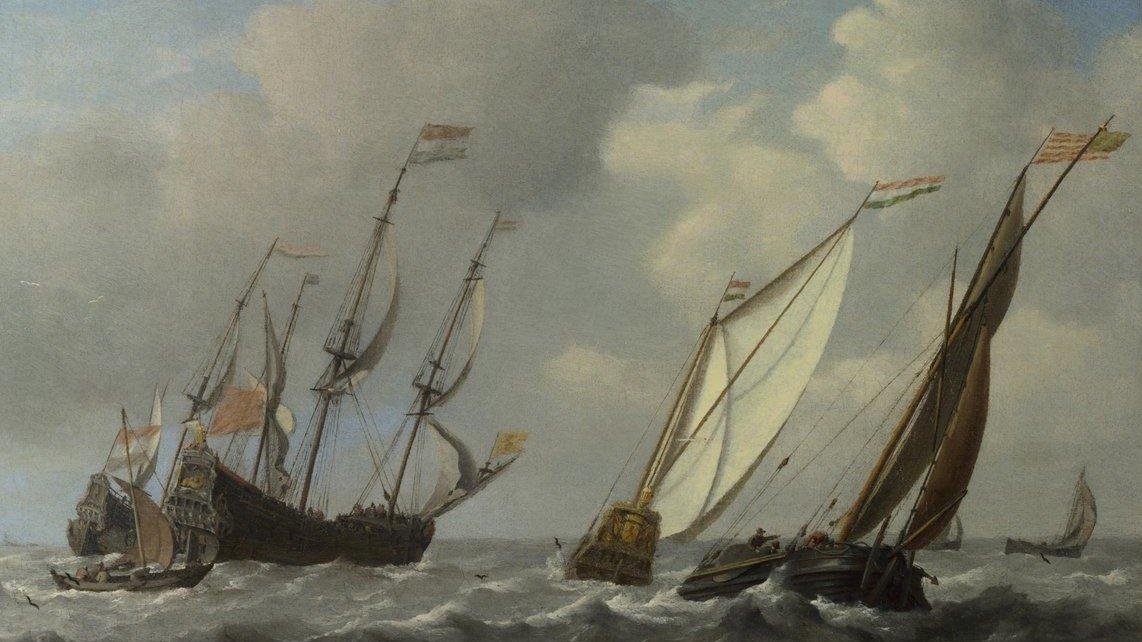
(Picture: A Dutch Ship, a Yacht and Smaller Vessels in a Breeze, c. 1660

Willem van de Velde the Younger)

The Allure of the Open Sea Part I

Private yachting is not merely a pastime; it represents a lifestyle, one that blends adventure with exclusivity and offers unparalleled freedom on the open water. At its core, private yachting revolves around the ownership or use of a vessel solely for personal enjoyment rather than commercial or competitive activities. It’s a world where practicality and luxury meet, offering the chance to explore far from the crowded shores, with ever-changing views and a pace set by the individual.

The term “yacht” wasn’t always synonymous with luxury. In the 17th century, as the Netherlands ascended as a dominant trading power, the Dutch jacht was both a defensive tool and a symbol of status. Originally designed to patrol waters and protect vital trade routes from pirates, these vessels played a critical role in securing Dutch commerce. Their agility and speed allowed captains to chase down threats in areas inaccessible to larger ships. However, as Dutch wealth grew, so did the purpose of the jacht. It evolved from a practical, military vessel into a statement of luxury and personal independence, marking a significant transformation in its identity.

At that time, “yacht” didn’t refer to a specific type of ship but was more of a broad term applied to various vessels with distinct purposes. For instance, the Schleswig-Holstein jacht was a small coastal freighter operating in the Baltic Sea, while the Blockzijlder jacht was a freighter navigating the Zuiderzee. Rather than a strict classification, the word “yacht” was used for ships suited to particular tasks, reflecting a broad spectrum of functionality and design.

Key Characteristics of the Dutch Jacht

1. Speed and Agility:Above all, the jachtwas built for speed. Its narrow beam and shallow draft enabled it to move quickly through coastal and inland waters, making it ideal for chasing down pirates or navigating shallow waters where larger vessels couldn’t venture.

2. Maneuverability:The jachtwas designed for swift, tight maneuvers, essential for the Dutch coastal and riverine environments. This agility allowed it to excel in defense and scouting missions, easily navigating narrow passages and shallow areas.

3. Shallow Draft:One of the jacht‘s defining features was its shallow draft, which allowed it to sail in waters too shallow for larger ships, providing access to tricky harbors and preventing the ship from running aground—crucial in the Netherlands’ coastal waterways.

4. Versatility:The jachtwas a multipurpose vessel, valuable for military tasks like patrolling or intercepting enemy ships, and flexible enough to serve as a dispatch vessel, scout, or even a command ship for fleet commanders.

5. Luxury and Ornamentation:As Dutch wealth increased, the jachttransitioned from a purely functional vessel to a status symbol. Wealthy merchants and naval officers began commissioning yachts with ornate carvings, gilded decorations, and lavish interiors, turning the jachtinto a floating symbol of power and prestige.

6. Durability and Construction:Typically built with sturdy oak for the hull and pine for the masts, the jachtwas crafted to endure the rough conditions of the North Sea, making it suitable for both military operations and extended luxury voyages.

Dutch writers such as Nicolas Witsen and Willem van Winschooten provide insight into the origins of the word “yacht.” The phrase “lagen ofte jacht maken,” meaning “to hunt or pursue another ship,” suggests that early yachts were smaller, fast vessels designed for speed, often tasked with intercepting other ships. Over time, “yacht” became a term of distinction, transcending its original military role.

The late 16th century, during the early stages of the Eighty Years’ War, likely saw the term “yacht” take root. Fast, maneuverable ships were essential for dispatch services and naval command, and by the early 1600s, “yacht” had become synonymous with vessels of both prestige and utility. Even warships commanded by naval officers doubled as symbols of status.

Witsen’s Specifications for the Jacht

Nicolas Witsen’s 1671 work, Aeloude en hedendaegsche Scheepsbouw en Bestier, provides detailed specifications of jachts from the period. He describes their narrow beams and shallow drafts, designed for speed and maneuverability—traits essential for a vessel intended to outrun its enemies. Witsen emphasized the importance of durable materials, such as oak for the hull and pine for the masts, and his designs laid the foundation for yachts used in both military and luxury contexts.

Willem van Winschooten’s Seeman: Zeewaardt op de Zee-vaart (1669) highlights the versatility of these vessels, describing how jachts were used for pirate hunting, message delivery, and fleet scouting. Winschooten’s focus was on their practical applications during the height of Dutch naval power, reinforcing their adaptability.

As Dutch wealth flourished during the Golden Age, so did the jacht’s association with luxury. What began as a swift defensive ship transformed into a vessel of opulence. Witsen noted that jachts became increasingly adorned with ornate carvings, gilded figureheads, and lavish interiors, commissioned by wealthy merchants to showcase their success.

By the time Witsen and Winschooten were writing, the jacht had become a symbol of the Dutch Golden Age itself—a reflection of the Republic’s ingenuity, prosperity, and maritime prowess. The blending of utility and luxury in the design of these vessels symbolized the height of Dutch maritime culture.

The next chapter, focusing on The Mary and Charles II, will explore how the restoration of the English monarchy influenced private yachting. Charles II, having experienced Dutch jacht culture during his exile, received The Mary as a gift from the Dutch after his return to England in 1660. This ship not only represented the maritime ties between England and the Netherlands but also helped introduce yachting as a leisure activity to British royalty, setting the stage for the future of private yachting in England.

Hub – The Allure of the Open Sea Part II
The Allure of the Open Sea Part II: A History of Private Yachting by Gregory C. Y. Piatkowski. #24/0165

October 26, 2024 · 6 min read


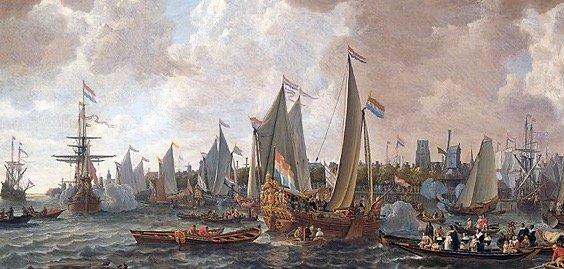
(Arrival of King Charles II of England in Rotterdam on May 24, 1660, painting by Lieve Verschuier | The yacht in the center of the painting might resemble what the yacht HMY Mary looked like.)

The Allure of the Open Sea – Part II: The Mary and the Birth of English Yachting

Private yachting is more than a pastime; it’s a lifestyle choice, a blend of adventure and exclusivity that offers freedom on the open water. At its heart, private yachting is the ownership or use of a vessel specifically for personal leisure rather than commercial or competitive purposes. It’s a realm where the practical meets the luxurious, where one can cruise at their own pace, far from the bustle of the shore, with a view that’s constantly changing.

The early days of English yachting were as much about diplomacy and national pride as they were about leisure and luxury. When Charles II returned to the throne in 1660, after years in exile during the turbulent English Civil War, he brought with him more than the hope of political stability—he brought a new fascination with maritime culture, inspired by his time in the Netherlands. It was there, amidst the bustling ports of a country that dominated global trade, that Charles was introduced to the jacht, a vessel that combined speed, elegance, and prestige. This newfound love for yachting would soon redefine England’s relationship with the sea.

At the heart of this transformation was The Mary, a yacht gifted to Charles II by the Dutch as a symbol of goodwill and diplomacy. But for Charles, the yacht became much more than a diplomatic gesture. It ignited his personal passion for the open sea, turning yachting into a royal pastime and a marker of status within the English court. Racing The Mary on the Thames, Charles not only embraced the excitement of competition but also showcased the power and agility of England’s naval potential in an era when maritime dominance was central to national identity.

Charles II’s Exile and Encounter with the Dutch Jacht

In 1646, sixteen-year-old Charles embarked on a journey into exile as his father fought desperately against Cromwell’s forces. He crossed the Channel under the protection of a Royal Navy frigate, destined first for the island of Jersey and later for France. During his time in The Hague, Charles encountered Cornelis de Graeff, the influential mayor of Amsterdam and president of the Dutch East India Company, a man renowned for both his political acumen and his ties to the powerful VOC. It was under de Graeff’s influence that Charles was first introduced to the jacht, a vessel smaller than the ships he’d known in England, but one perfectly crafted for both speed and grace—a practical and symbolic emblem of Dutch maritime prowess.

Upon his return to England, Charles received The Mary, a sleek, 17-meter-long vessel rigged with a gaff sail and two headsails, her lines drawing inspiration from the Dutch designs he admired. This vessel wasn’t simply a gift; it was a spark, igniting an enthusiasm for yachting that would capture the attention of England’s noble class and instill a newfound reverence for the open sea.

A Royal Race on the Thames: Rivalry and the Birth of Yachting

In October 1661, Charles, now king, and his brother James, Duke of York, decided to put their vessels to the test in what would become one of the earliest documented yacht races. Charles sailed The Catherine, built by Christopher Pett, while James took to the helm of The Anne, crafted by Pett’s brother, Peter. They agreed on a straightforward course, sailing from Greenwich to Gravesend and then back. The wager: £100 to the victor. Against the headwind on the outward leg, James’s Anne surged ahead, but on the return leg, with a favorable tailwind, The Catherine gained the advantage, each brother claiming victory on one leg of the journey.

This race, meticulously recorded by courtier and scholar John Evelyn, marked the beginning of English yachting. Evelyn noted the lively scene, with courtiers on board, and the Thames transformed into an impromptu racecourse. This October day would later be celebrated as the symbolic birth of yachting, setting the stage for competitive sailing in England and popularizing the term “regatta,” borrowed from Venetian gondola racing.

Yachting’s Legacy: Passion, Power, and Prestige

Charles’s enthusiasm for The Mary and her successors drew England’s noble class into his maritime world. But after his death in 1685, many of the yachts he inspired were absorbed into the Royal Navy, and the thrill of yachting began to wane. Yet the impact of that October day remained: the race on the Thames had established yachting as a pastime that carried both the prestige of courtly life and the spirit of maritime ambition.

In the decades that followed, yachting would grow from royal amusement to national sport, a pursuit intertwined with England’s growing naval power and her role as a global maritime leader. Charles II’s passion for The Mary and the thrill of competition at sea would endure, leaving an indelible mark on English maritime culture and paving the way for a tradition that would inspire generations to embrace the allure of the open sea.

As Charles II’s reign approached its final chapter, an unusual anecdote lingers in the archives of his court—a glimpse into the curious, sometimes dark, lengths the king went to in pursuit of vitality. For weeks, Charles had felt wretched, his body fatigued and his mind dulled. But on this particular February 2nd, 1685, he awoke in an especially alarming state. His body burned with fever, his head pounding with a ferocity that seemed fit to burst. The court physicians, always nearby, were ready with various herbal preparations. Yet Charles had a different remedy in mind—a bizarre tonic he’d grown to rely upon over the years.

The remedy, known as “The King’s Drops,” had an exotic, almost sinister origin. Crafted from finely ground human skull bones, dried snake skin, powdered deer antlers, and a hint of ivory, this tincture was the product of Dr. Jonathan Goddard, former physician to Charles’s father. A pioneer in experimental medicine and a member of the Royal Society, Goddard had passed on this peculiar formula to the young king, who used it to stave off the effects of stress and fatigue. The usual dose was modest—just eight drops mixed in wine or stirred into fine chocolate. But on this desperate morning, Charles demanded a more powerful dose: fifty drops, undiluted and on an empty stomach.

The skulls used in this concoction were far from ordinary. Dr. Goddard insisted that the bones of young, vital men who had met violent ends—those hanged or beheaded—contained the “optimal quality.” Such exacting requirements had given rise to a shadowy network of hangmen and gravediggers who discreetly supplied the necessary “materials.” It was a grim irony: these miracle drops hadn’t spared Charles I, beheaded during the English Civil War before he could even reach fifty. Nor had they preserved Oliver Cromwell, the very man responsible for Charles I’s execution, despite Goddard’s continued services after the fall of the monarchy.

And yet, even after the monarchy’s restoration, the allure of these “Cannibal Drops” was unstoppable. Charles II took to the formula with great enthusiasm, experimenting with skull mixtures in his own royal chemistry lab. But as his illness deepened and his doses grew more intense, the tincture could not stave off fate. Four days later, on February 6th, Charles II took his final breath.

In the aftermath, “The King’s Drops” became a sensation. Queens, bishops, and noblemen clamored for the miraculous elixir, and the tincture—once a bizarre private indulgence of Charles II—gained a regal reputation. It became a symbol of the mysterious allure of alchemy and power, forever tied to the legacy of the king who had loved both the open sea and the occult’s dark, unknown depths.

In the next chapter, readers will journey into the spread of yacht clubs throughout Europe, following in the footsteps of the Royal Cork Yacht Club’s pioneering spirit. This expansion marked the beginning of a more structured approach to yachting, with an emphasis on organized regattas, camaraderie, and the sharing of maritime knowledge. As yacht design shifted towards greater speed and maneuverability, competitive sailing evolved from a leisurely pursuit to a more refined and strategic sport. Readers can look forward to exploring how these early developments laid the foundation for modern yachting competitions and established the sport as a symbol of prestige and passion for the open sea.

post scriptum:

Step into the opulent world of Charles II’s court! This exhibition invites you to experience a day in the life of 17th-century royalty, where decadence, diplomacy, and drama come alive. Stroll through magnificent halls adorned with lavish artworks, encounter the elegance of Baroque style, and feel the pulse of courtly intrigue. Engage with immersive displays that reveal how art, fashion, and politics interwove in the life of one of England’s most enigmatic kings. A visit here is more than a journey through history; it’s an invitation to live a day at the court, just as the nobility once did:

https://www.ausstellung-charles2.phil.fau.de/en

Hub – Piracy On The Seas

Piracy on the Seas: A Socioeconomic Struggle Across Centuries. A Prelude to a History of Maritime Piracy by Gregory C. Y. Piatkowski. #24/0168.

October 27, 2024 · 3 min read


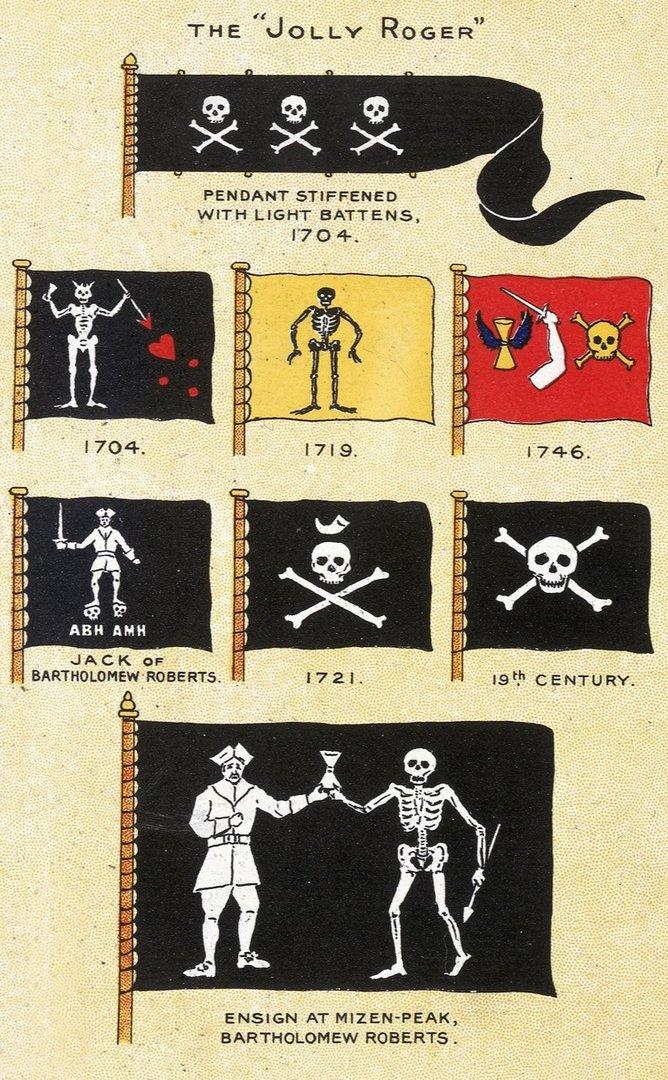
(A selection of 18th century pirate flags,Basil Lubbock)

Piracy on the Seas: A Socioeconomic Struggle Across Eras

Maritime piracy is the act of robbery, violence, or other criminal acts committed on the high seas or in coastal waters, typically involving the unauthorized boarding and seizure of a vessel by individuals or groups with the intent to steal cargo, demand ransom, or harm crew and passengers. Historically, maritime piracy has been a socio-economic phenomenon, often arising from economic hardship and targeting wealth in transit, reflecting a struggle between those excluded from the benefits of trade and those who control it.

For as long as goods have been transported by sea, piracy has followed. Rooted in the margins of society, piracy reveals an enduring struggle between wealth and poverty, authority and rebellion, the powerful and the disenfranchised. While popular culture often casts pirates as romantic adventurers, the reality is that piracy has been an economic and social reaction to inequality across centuries and continents. From ancient raiders on the Mediterranean to the golden-age buccaneers of the Caribbean and modern pirates in Southeast Asia and off the coast of Somalia, piracy is a complex story of survival and resistance.

This series will explore piracy as a socioeconomic phenomenon, born from the struggles of marginalized communities and fueled by the unbalanced distribution of wealth. Each chapter will dive into a distinct era and region, uncovering how piracy has evolved alongside—and often in opposition to—global maritime trade and shifting power dynamics.

Chapter Overview

Chapter 1: The Beginnings of Maritime Piracy

Piracy’s origins trace back to the dawn of maritime trade, with ancient records of raiders such as the Sea Peoples disrupting Egyptian and Aegean trade routes. This chapter explores how piracy first emerged as a response to economic hardship and scarcity, reflecting early forms of rebellion against centralized wealth.

Chapter 2: Medieval Piracy and the Rise of the Coastal Raider

As Europe entered the Middle Ages, piracy took on new forms along the coasts of the Mediterranean and the Baltic Sea. This chapter delves into how local communities turned to piracy to combat poverty, survive shifting political landscapes, and navigate emerging powers like the Hanseatic League.

Chapter 3: The Golden Age of Piracy – Rebellion in the New World

In the 17th and 18th centuries, piracy in the Caribbean reached its height. This chapter highlights famous pirates and their crews, who defied colonial powers and attacked wealthy merchant vessels, revealing how piracy became an alternative life for those marginalized by imperial expansion.

Chapter 4: Privateers and the Blurred Lines of Legitimacy

Piracy and privateering intersected during the age of empire-building, as states granted letters of marque to private vessels, encouraging them to plunder enemy ships. This chapter examines how governments exploited piracy for economic gain and blurred the line between piracy and sanctioned warfare.

Chapter 5: Pirates Beyond the Caribbean – A Global Expansion

While the Caribbean often dominates the narrative of piracy, this chapter explores piracy hotspots worldwide, from the Barbary Coast to the Indian Ocean and Southeast Asia. Each region had its socioeconomic backdrop, with piracy thriving where local communities faced marginalization and economic disadvantage.

Chapter 6: Modern Piracy – Economic Desperation in a Globalized World

Piracy persists in today’s oceans, from the Somali coast to the Straits of Malacca. This chapter reveals how poverty, political instability, and economic exploitation continue to drive piracy, highlighting the socioeconomic parallels with historical piracy and the impact on modern maritime security.

Chapter 7: The Legacy of Piracy – Cultural Influence and the Eternal Struggle for Equality

This final chapter examines the lasting cultural legacy of piracy, from folklore and literature to the influence of pirate ideals on modern social movements. It reflects on how the enduring appeal of pirates speaks to a deeper, unresolved struggle against inequality and concentrated wealth.

In exploring piracy across different periods and regions, this series will reveal how it has continuously served as a mirror to the social and economic realities of its time. Each chapter will invite readers to see beyond the myth and understand piracy as a persistent, complex phenomenon woven into the fabric of maritime history.

Hub – Chi Kung: The Secret to Balance and Energy on Board

Chi Kung: The Secret to Balance and Energy on Board. A Short Introduction Into The Art of Chi Kung by Gregory C. Y. Piatkowski. #24/0148.

March 1, 2025 · 5 min read


Chi Kung: The Secret to Balance and Energy on Board

As a yachtie, you know all too well the pressures of the job: physical exertion, long shifts, and constantly changing environments. Often, there’s little time to unwind and realign your body and mind. This is where Chi Kung, an ancient Chinese practice, can provide a much-needed boost in energy, inner peace, and flexibility.

What is Chi Kung?

Chi Kung (or Qigong) is a holistic practice that combines movement, breathing, and meditation to regulate the body’s energy flow. “Chi” stands for life energy, while “Kung” represents the conscious work with this energy. Gentle yet powerful movements help to release blockages caused by stress, physical strain, and emotional tension.

Why Chi Kung for Yachties?

As a yachtie, achieving the right balance between physical work and mental relaxation is essential. Chi Kung offers you a way to strengthen this balance. The slow, flowing movements increase flexibility and improve posture, which is crucial for long hours on deck or in tight spaces. Meanwhile, the breathing techniques help calm the nervous system and reduce stress.

Practicing Chi Kung regularly can relieve muscle tension and bring you back to your center, even amidst turbulent seas. In stressful situations that often arise on yachts, Chi Kung enables you to stay calm and focused.

The Benefits of Chi Kung

• Flexibility and Mobility: The flowing movements of Chi Kung relieve tension and promote a healthy posture – ideal for long hours on board.

• Stress Relief: Through meditative elements, Chi Kung helps reduce mental tension and enhance clarity.

• Improved Breathing: The breathing techniques boost oxygen intake and endurance, essential for physically demanding jobs.

• More Energy: Regulating your energy flow leaves you feeling vitalized and refreshed, even after long workdays.

My Experience with Chi Kung and My Teacher

My journey with Chi Kung began several years ago when I sought ways to cope with the physical and mental demands of my life. I discovered Eva Caimari Caldes, a Chi Kung master based in Palma de Mallorca. She showed me how, through simple movements and breathing exercises, I could access a new level of energy and calm. Her experience and wisdom helped me understand the profound benefits of this ancient practice, and now I’m eager to share it with you.

Eva Caimari runs a center in Palma that is dedicated to healing and transformation through Chi Kung. There, I learned that Chi Kung is not only a physical exercise but a lifestyle that aligns the body and mind.

Chi Kung Exercises Inspired by Wang Xiangzhai

Here are some fundamental exercises based on Wang Xiangzhai’s teachings. He founded the lineage of masters my Laoshi in Kung Fu training, Ricardo Cussatti, adheres to. Wang focused heavily on Zhan Zhuang, or standing meditation, which emphasizes stillness, alignment, and energy cultivation within a single position. These exercises are particularly suited to yachties seeking stability, both on and off the water.

1. Zhan Zhuang (Standing Meditation)

The foundation of Wang Xiangzhai’s teachings, this exercise involves standing still to cultivate internal energy and mental clarity.

• Stand with feet shoulder-width apart, knees slightly bent, and arms held in front as if embracing a large tree trunk.

• Relax your shoulders and close your eyes. Let go of tension in your body, and focus on feeling rooted through your feet.

• Visualize energy flowing up through your feet and circulating throughout your body. Hold the position for 5-10 minutes, working up to longer durations as you become more comfortable.

• This exercise strengthens both body and mind, making it an ideal daily practice to cultivate resilience and a sense of calm.

2. Hun Yuan Zhuang (Posture of Primordial Unity)

This exercise emphasizes full-body alignment and harmony, grounding you in a powerful but relaxed stance.

• Stand upright, feet shoulder-width apart, with arms by your sides. Let your body naturally relax into a balanced posture.

• Shift your focus to your center of gravity, the area just below your navel, known as the Dantian.

• Allow your breath to deepen, and visualize energy radiating outward from the Dantian to fill your entire body. Feel a sense of unity and stability in this position, staying here for 5-10 minutes.

• Wang emphasized the importance of this position as a way to center oneself, calm the mind, and cultivate inner strength.

3. Yiquan (Mind-Intent Boxing)

A method created by Wang, Yiquan focuses on using mental intention to direct energy through the body, which is ideal for improving focus.

• Stand in Zhan Zhuang stance and begin by visualizing specific movements in your mind, such as pushing or pulling.

• Engage your intent without physically moving—imagine you’re pushing against a solid object or pulling something heavy.

• Keep your muscles relaxed, and focus on the sensations in your body as you mentally execute these actions.

• Yiquan is a valuable practice for yachties to develop mental focus and body awareness, key for the physically demanding tasks on board.

4. Shili (Testing Force)

This exercise combines subtle movements with mental intention to help develop sensitivity and power in the body.

• Stand in a relaxed posture with your arms slightly extended in front of you. Imagine your arms are pressing against a wall of water.

• Slowly shift your weight from one foot to the other, feeling the connection between your feet, legs, and arms as you move.

• Focus on the sensations in your body, allowing the energy to flow with each shift. Practice this for 5-10 minutes, tuning in to the energy and force as it circulates.

• Shili is ideal for improving body coordination and cultivating a sense of control over physical exertion, valuable skills for any yachtie.

5. Fang Song Gong (Relaxation Practice)

A relaxation-focused exercise that Wang Xiangzhai recommended to release tension and refresh the body.

• Sit or stand comfortably, close your eyes, and take several deep breaths.

• Starting from the top of your head, consciously relax each part of your body, working your way down to your feet.

• Imagine any stress or tension melting away with each exhale. When you reach your feet, visualize your body filled with light and ease.

• This practice is ideal for unwinding after a long shift or mentally preparing yourself for the demands of the day.

Take the Next Step: Try It Out!

If you’re curious to explore Chi Kung further, consider visiting Eva’s Oriental Arts Research Center or reaching out to me. You may find that Chi Kung not only strengthens the body but also renews the spirit, allowing you to meet the challenges of life at sea with newfound resilience.

Embrace the quiet power of Chi Kung, and let it transform your time on the water into an opportunity for renewal and connection.

The Silent Role of a Chef on Board

26/0051. By Chef Grecia Vargas.

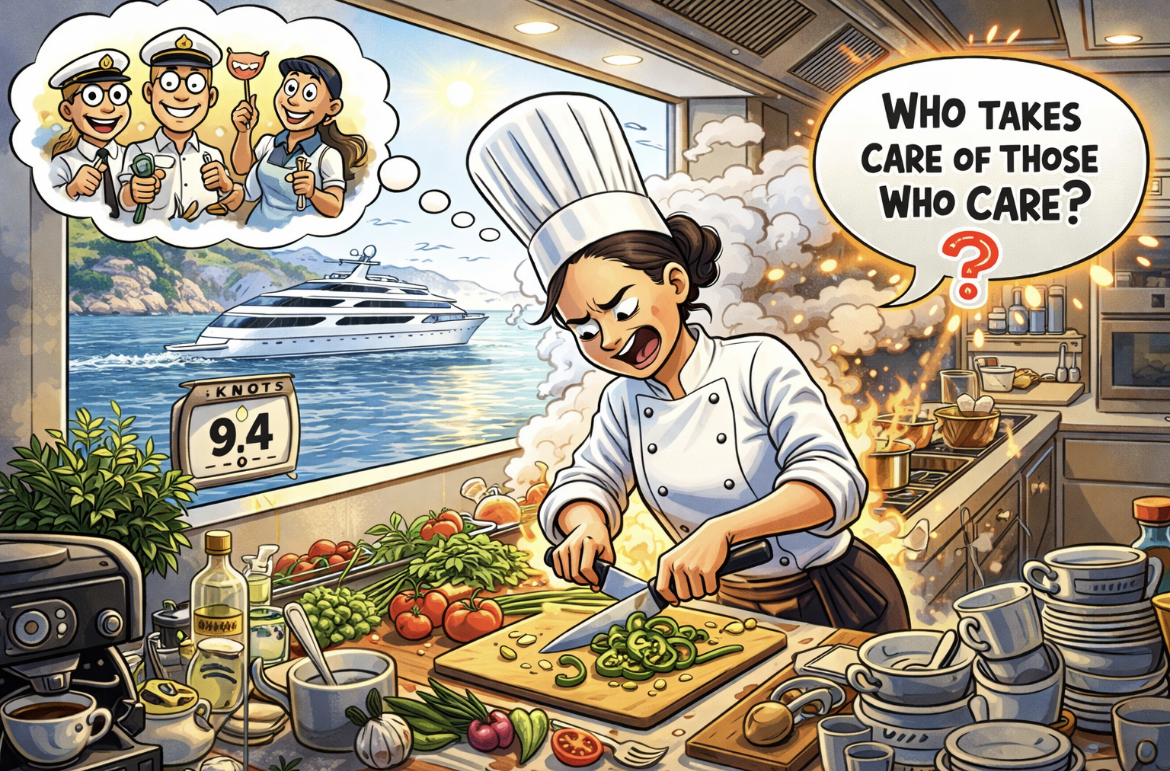
The Silent Role of a Chef On Board: Who Takes Care of Those Who Care?

By Grecia Vargas

Reflections from the galley on the invisible care that sustains life on board a superyacht.

Dear industry,

I write this with genuine affection.

To acknowledge what this world has given me — the moments, the lessons, the intensity of it all.

Yachting is a fascinating environment.

You learn every day.

You live in confined spaces with people who were once strangers.

You maintain a positive mindset, no matter the circumstances.

You focus on detail.

You deliver high standards.

You work long hours.

You manage exhaustion.

Meals go out on time.

Everything stays clean and in order.

You remain professional.

You smile — even while cruising at 9.4 knots somewhere along the Mediterranean coast.

This is life on board.

A constant balance between attitude and professionalism.

In my case, that balance lives in the galley.

The role of a chef is central.

It is also exposed and demanding.

When guests come on board, expectations are clear:

Impeccable food.

Personalised.

Consistent.

No room for error.

But there is another side to this.

The crew.

They become your family for the season.

You live together.

Work together.

Push through together.

Their performance defines the experience.

Safety. Comfort. Enjoyment.

Everything depends on how well the team functions.

This is not a small responsibility.

The entire operation rests on one mission:

To create an unforgettable experience.

So the question is:

What does that success really depend on?

The answer is simple.

And often overlooked.

The human body has limits.

It needs sleep.

Food.

Recovery.

Stability.

Remove these, and performance breaks down.

Yet this profession demands the opposite.

Less sleep.

Interrupted rest.

Constant alertness.

Irregular meals.

No real rhythm.

Balance is fragile.

This is where the silent role of the chef begins.

During the peak of the season, there is no pause.

The crew must perform, every day.

Food becomes more than food.

It becomes fuel.

Recovery.

Support.

Through nutrition, the chef tries to compensate for the physical and mental strain placed on the team.

This often goes unnoticed.

Or is simply accepted as part of the job.

Something to deal with later.

“At the end of the season.”

But the reality is clear:

The galley does not just feed people.

The galley sustains the vessel.

Behind every smooth operation, there are people.

And those people need care.

Like an orchestra needs tuned instruments,

a crew needs to be maintained.

So the question returns:

Who takes care of those who care?

From the galley, the answer is quiet but constant.

Every meal is more than a task.

It is an act of support.

Three times a day, the crew is restored.

Energy is rebuilt.

Effort is acknowledged.

The galley becomes something close to sacred.

A place where wellbeing is sustained.

Because behind every perfect service,

every seamless voyage,

every unforgettable summer —

there is a human team making it happen.

And we, the chefs,

keep that system alive.

Quietly.

Plate by plate.

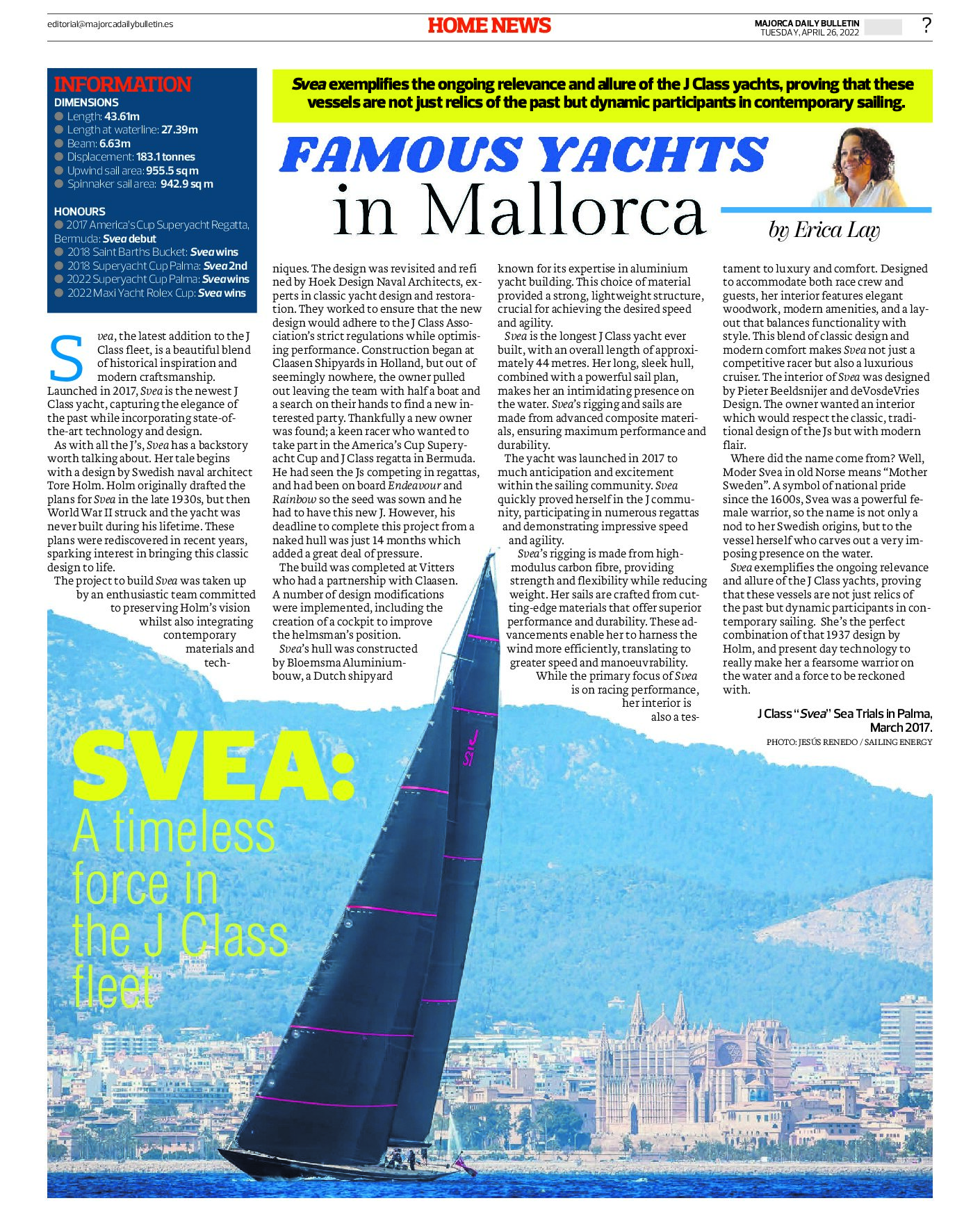
Famous Yachts in Mallorca

With Courtesy of Erica Lay & The Mallorca Bulletin. #25/1023.


Erica Lay owner of EL CREW International Yacht Crew Agency http://www.elcrewco.com/ erica@elcrewco.com

Svea exemplifies the ongoing relevance and allure of the J Class yachts, proving that these

vessels are not just relics of the past but dynamic participants in contemporary sailing.

SVEA (2017) – J Class Series

Svea, the latest addition to the legendary J Class fleet, is a stunning fusion of historical inspiration and cutting-edge craftsmanship. Launched in 2017, Svea is the newest J Class yacht, capturing the timeless elegance of the 1930s while incorporating the technology and materials of the modern era.

As with all the Js, Svea has a backstory worth telling.

Her journey began with a design by renowned Swedish naval architect Tore Holm, who originally drafted the plans in the late 1930s. But with the outbreak of World War II, the yacht was never built during his lifetime. The original drawings were rediscovered decades later, sparking renewed interest in bringing Holm’s vision to life.

Bringing Svea to Life

A dedicated team of enthusiasts set out to build Svea in a way that honoured Holm’s original design while integrating modern techniques. Hoek Design Naval Architects, specialists in classic yacht design and restoration, refined the lines to meet the strict standards of the J Class Association and maximise racing performance.

Construction began at Claasen Shipyards in Holland. But midway through the build, the owner unexpectedly pulled out, leaving the team with a partially completed hull and an urgent need to find a new backer.

Fortunately, a new owner stepped in—a passionate sailor who had been inspired by sailing aboard Endeavour and Rainbow, and watching the J Class race at regattas. He wanted Svea completed in time for the 2017 America’s Cup Superyacht Cup and J Class Regatta in Bermuda, giving the yard just 14 months to go from a bare hull to a fully race-ready yacht.

The project was completed by Vitters Shipyard, who collaborated with Claasen. Design tweaks included a reimagined cockpit to improve visibility and control for the helmsman.

Design & Construction

Svea’s hull was built by Bloemsma Aluminiumbouw, a Dutch shipyard known for its aluminium expertise. The use of lightweight aluminium was key to creating a structure that is both strong and fast.

At 44 metres, Svea is the longest J Class yacht ever built. Her sleek profile and powerful sail plan give her a commanding presence on the water. The rigging is made from high-modulus carbon fibre, combining strength with weight savings. Her sails, crafted from state-of-the-art composite materials, maximise both performance and durability.

Svea was launched to widespread anticipation and quickly proved herself on the racecourse. Her speed, agility, and graceful lines earned her an enthusiastic welcome into the J Class fleet.

Interior Elegance

Though performance is a priority, Svea’s interior is also a celebration of craftsmanship and comfort. Designed to host both race crew and guests, her interior reflects the tradition of the J Class while introducing a modern touch. Designers Pieter Beeldsnijer and deVosdeVries Design created a space that feels classic yet contemporary—warm woods, elegant lines, and high-end finishes define the guest areas.

The result? A yacht that performs like a racer but lives like a cruiser.

What’s in a Name?

Svea comes from “Moder Svea,” meaning Mother Sweden in Old Norse—a national symbol and female warrior figure since the 1600s. The name is both a nod to her Swedish design heritage and a fitting title for a yacht that cuts such an imposing figure on the water.

Svea is living proof that the J Class yachts are far more than relics of a bygone era. She embodies both the spirit of 1937 and the innovation of today—an elegant warrior, purpose-built to race, cruise, and command attention. In the ever-evolving story of the J Class, Svea is a proud and powerful new chapter.

Yacht crew – wanna share your story?

Theflyingfish #25/01000. By Veronique Habela.

My name is Veronique

I’m a former yachty myself, now working as a journalist. Currently, I am writing a piece for DIE ZEIT, one of Germany’s most respected newspapers, and I’m looking to speak with crew members about their experiences onboard. The idea is to compile a few interviews with different crew members who share the in’s and out’s of their jobs.

I’d love to hear from captains and engineers – but also speak with chefs, stews, deckhands, dive instructors, nannies, laundry crew – everyone who keeps the boat running.

What’s the reality of life at sea? What are the challenges that outsiders don’t see? What moments make it all worthwhile?

We’ll also talk about earnings, the ups and downs of crew culture, and the most unforgettable or bizarre experiences you’ve had on board.

I am particularly interested in speaking with German or Austrian crew members, but all nationalities are welcome.

Anonymity is absolutely possible if you prefer not to be named.

If you’re open to a relaxed and confidential conversation, please feel free to reach out to me.

+49 152 171 50 276

Love, Veronica

Hub – Addressing Bullying and Sexual Harassment

Addressing Bullying and Sexual Harassment in the Yachting Industry: A Guide for TheFlyingFish Members. #25/0039.

March 1, 2025 · 2 min read


Addressing Bullying and Sexual Harassment in the Yachting Industry: A Guide for TheFlyingFish.eu Members

The yachting industry offers unparalleled opportunities for adventure and career growth. However, it’s essential to acknowledge and address challenges such as bullying and sexual harassment. At TheFlyingFish.eu, we are committed to fostering a safe and respectful environment for all our members.

This guide aims to inform and empower you with the knowledge and resources to handle such situations effectively.

Understanding Bullying and Sexual Harassment

• Bullying: Repeated, unreasonable actions directed towards an individual or group, intended to intimidate, degrade, or humiliate.

• Sexual Harassment: Unwelcome behavior of a sexual nature that creates an intimidating, hostile, or offensive environment.

Steps to Take if You Experience or Witness Misconduct

1. Document the Incident:

• Record dates, times, locations, involved parties, and any witnesses.

• Maintain copies of any relevant communications or evidence.

2. Report the Behavior:

• Internal Reporting:

• Familiarize yourself with your vessel’s anti-harassment policies.

• Report the incident to your immediate supervisor or designated onboard contact.

• External Reporting:

• If internal channels are ineffective or compromised, consider external avenues:

• Designated Person Ashore (DPA): Acts as a liaison between the crew and management, ensuring safety and proper conduct.

Key Resources for Yacht Crew:

✅ ISWAN’s Yacht Crew Help – A free, confidential, 24/7 helpline providing emotional support and practical advice.

📞 +44 (0)20 3713 7273

📧 help@yachtcrewhelp.org

🌐 www.yachtcrewhelp.org

✅ Professional Yachting Association (PYA) Welfare Group – Advocates for crew members facing bullying and harassment.

🌐 www.pya.org/services/welfare-group

✅ Nautilus International – A maritime professionals’ union assisting crew with employment rights, harassment cases, and legal support.

🌐 www.nautilusint.org

✅ Safer Waves – Provides a confidential space for seafarers affected by sexual assault or harassment.

🌐 www.saferwaves.org

✅ CHIRP Maritime – An independent reporting program for unsafe practices, including bullying and harassment.

🌐 www.chirpmaritime.org

Seek Support:

• Engage with trusted colleagues, friends, or family members.

• Consider professional counseling services if needed.

Conclusion

No one should endure bullying or sexual harassment. By staying informed, supporting one another, and utilizing available resources, we can work together to maintain a safe and respectful environment in the yachting industry. Remember, TheFlyingFish.eu is here to support you every step of the way.

Hub – Introducing Weingarth Customs

Craftsmanship, Passion, and Yachting Culture by Amanda Weingarth. #25/0006.

January 8, 2025 · 3 min read


Weingarth Customs represents the pinnacle of bespoke craftsmanship, merging tradition with cutting-edge design to deliver unparalleled custom solutions. Whether it’s luxury furnishings, high-end yacht interiors, or tailor-made innovations, Weingarth Customs elevates artistry into an experience.

Visit: https://weingarthcustoms.com

Weingarth Customs: Craftsmanship, Passion, and Yachting Culture.

If you told me 10 years ago that I’d be living on a sailboat with my husband, Chris, and our two dogs, I would’ve laughed. And yet, here we are—living a life shaped by the sea and blending our passion for sailing with a family business that thrives in the refined world of yachting. In yachting, where elegance meets functionality, the smallest details carry the greatest weight. A single scratch, a nick, or a marred surface can disrupt the harmony that defines these vessels. At Weingarth Customs, Chris and I have dedicated ourselves to preserving that harmony through meticulous craftsmanship and personalized service, blending artistry with utility in every project we undertake.

Weingarth Customs began over 15 years ago in Upstate New York, where Chris honed his expertise in design and fabrication for luxury homes. His ability to tackle complex challenges with creativity and precision became the cornerstone of our business. When we moved to South Florida, this legacy transitioned seamlessly into the world of yachting. Chris noticed a common issue on yachts: minor damages to panels, walls, or cabinets often led to full replacements. Knowing there had to be a better way, he developed a touch-up repair service that saves time, reduces costs, and preserves the original integrity of the yacht. This approach has revolutionized how yacht owners maintain their vessels, offering a sustainable and elegant alternative to full-scale replacements.

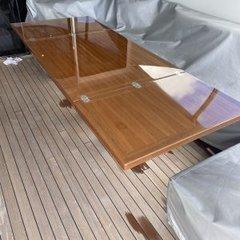
When I joined Chris in the business, I fully embraced the ethos of precision and care. Together, we’ve mastered the art of touch-ups, repairing dings, scratches, screw holes, and water damage on wood, laminate, painted, and composite surfaces. These seemingly small details make a world of difference, ensuring that every yacht we work on remains as beautiful as the day it was launched. Beyond repairs, we’ve introduced innovative solutions like Paint Protection Film (PPF). This ultra-thin, transparent urethane film provides a shield for high-use areas—countertops, marble bars, dining tables, and more—protecting them from daily wear and tear. PPF complements our touch-up work, ensuring that every yacht remains not only flawless but also future-proof.

Our services extend beyond simple fixes. We bring artistry into the yachting world with specialties like gold and silver leafing and faux painting, adding custom, luxurious touches to each vessel. These projects allow us to celebrate the intersection of function and beauty, creating spaces that are not just restored but elevated. Our work is deeply personal. Sailing isn’t just a hobby for us—it’s our lifestyle. It started with a spontaneous trip to Bimini, and before we knew it, we were sailing regularly, restoring an old Hobie Cat, and becoming part of a vibrant sailing community. For the past eight years, we’ve lived full-time on a sailboat, immersing ourselves in a world we love.

Living on the water has given us a unique perspective on the importance of preserving yachts. We understand firsthand the joy these vessels bring and the pride owners take in their upkeep. That’s why we pour our hearts into every project, treating each yacht as if it were our own. Weingarth Customs is more than a business—it’s a tribute to the yachting lifestyle. Every repair, every application of PPF, every artistic touch reflects our respect for the craftsmanship that defines this world. We aim not just to restore yachts but to preserve their stories, ensuring that they remain as timeless as the sea itself. As we continue to serve the yachting community, we’re reminded daily that the true soul of a yacht lies in its seamless blend of function, artistry, and enduring beauty. For Chris and me, it’s not just about fixing what’s broken—it’s about celebrating the elegance, integrity, and culture of yachting. After all, this isn’t just our job. It’s our passion, our lifestyle, and our way of contributing to the world we love.