The Michelin-Sysco Revolution

#26/0311.
The Michelin-Sysco Revolution: The Day Fine Dining Lost Its Soul.
There was a time when a chef cooked!
You could recognize him by his burned hands, his greasy hair, his permanent smell of garlic, and the expression of a man who had just survived a Saturday night with 200 covers and a broken combi oven.
Marco Pierre White. Gordon Ramsay in his early days. Mario Batali before the celebrity circus. Those were chefs who looked like they had actually been inside a kitchen.
Today, you walk into some kitchens and wonder if you accidentally entered a luxury hair salon.
Perfect manicure. Designer chef jacket. Exotic tattoos, Ponytail. Chanel reading glasses. You get the picture.
“Excuse me, can I speak to the chef?”
“He’s not here. He’s in the Caribbean doing a photo shoot for his new cookbook.”
The Chef is not cooking, he’s influencing!
And then, my friends, came the announcement that would change gastronomy forever.
Sysco, the giant food mass production empire, had partnered with the Michelin organization.
The press release said:
“We are proud to bring Michelin-level culinary excellence to every kitchen on the planet.”
Michelin-level excellence from a truck?
Ladies and gentlemen, the future had arrived. And apparently, it was frozen.
The new Michelin experience!
Long gone were the days of making sauces from scratch.
Why spend three days making demi-glace when Sysco could deliver a five-gallon bucket of something that had been reduced somewhere in Doral, Florida, by a man who had never heard of Auguste Escoffier?
Why spend six hours making sourdough when you could order “Organic Artisan Sourdough bread Previously Frozen Michelin Collection”?
Why make pastry when the pastry division could send you a box of perfectly identical desserts, each one looking like it had been manufactured by a Swiss watchmaker with no soul?
The new Michelin-Sysco catalog offered everything:
Award-winning salad dressings.
Farm-to-table vegetables providing the farm was located next to the truck and the table had enough freezer space.
Handcrafted sauces by somebody who pressed a button.
And, of course, the revolutionary Twelve-Course Tasting Menu in 60 Minutes.
The chef simply opened the freezer, pulled out twelve containers, arranged everything on beautiful plates, and voilà!
“Chef, how did you achieve such extraordinary execution?”
“Years of training, dedication, and a very reliable delivery driver.”
The Michelin inspector took one bite.
“Magnifique!”
The chef smiled.
“Thank you.”
He did not mention that “The Canard à l’orange” had arrived in a plastic bag.
But the real miracle was happening in yachting.
The modern yacht chef was now expected to be:
Executive Chef. Sous Chef.
Pastry Chef. Baker. Crew Chef. Purchaser. Provisioner. Storekeeper. Administrator. Galley cleaner and occasionally, the personal chef for the Captain’s family.
All in one person for 120 days without interruption. No crew cook. Limited refrigeration and freezer the size of a coffin.
A pantry designed by somebody who had never cooked a meal a galley shared with the interior crew because apparently the stewardesses needed somewhere to store 400 glasses of champagne.
Meanwhile, the future employer writes:
“Seeking Michelin-starred chef for private yacht/estate.
Must be flexible, organized, creative, and able to produce a 12-course tasting menu at short notice, yes Short notice?
My friend, I have just fed 16 crew members, provisioned the vessel, cleaned the galley, checked the food inventory, answered seven WhatsApp messages from the owner, and discovered that the Captain has taken half the chicken breasts home for his family.
Now you want me to produce a twelve-course tasting menu gluten free, nuts free and soul free. All ingredients organic of course.
Give me five minutes.
I will simply pull the ingredients out of my ass.
What else would a Michelin chef do?
The employer probably thinks Michelin is a magical word that turns one exhausted human being into six trained professionals.
This is not fine dining.
This is culinary science fiction.
And the chef is the unpaid special effects department.
I sometimes struggle to understand why people in the yachting industry still place so much importance on Michelin stars.
I have eaten in Michelin-starred restaurants. Some have been fantastic. I still fantasize about returning to The French Laundry in Napa Valley, Mirazur outside Monaco, and other extraordinary restaurants that I had the privilege of experiencing exceptionally tasting food.
But let me tell you something.
Those kitchens have brigades.
Eighteen, twenty-five, sometimes more, chefs working in perfect synchronicity.
One person makes the sauce, another handles the fish, another prepares the vegetables, another works pastry, another impeccably executes plating. Another supervises. Everybody has a station. Everybody has a responsibility.
That is how you produce exceptional food consistently.
Now take that same expectation and give it to one yacht chef. One person.
One galley designed by Gucci. One house refrigerator, one chest freezer. One hundred last-minute requests. Different countries. Different suppliers, ingredients.
Limited storage and counter space. No crew cook and no pastry chef.
No rest and the expectation is Michelin-level execution.
My friends, that is not a culinary challenge.
That is a psychiatric experiment.
What happened to good food?
The original idea of fine dining was never supposed to be about a star on the wall. It was about craftsmanship, seasonality, hospitality and respect for ingredients. Respect for the guest. Respect for the people doing the work.
But somewhere along the way, we started confusing expensive with exceptional.
A $100,000 menu budget, famous chef, a spacious mediocre dining room that most of the time is empty.
A bottle of wine that costs more than a crew member’s monthly salary.
And suddenly, everybody is an expert.
But ask some people to identify a real tomato from a supermarket tomato, or explain what seasonal cooking means, and you get the same expression as a guest who has just been told the Wi-Fi is not working.
Perhaps some people were raised on microwave dinners and television trays. Perhaps they never had the opportunity to develop a food culture.
And perhaps the industry has done a magnificent job convincing them that a star is more important than the food itself. I don’t know.
But I do know this:
A Michelin star does not automatically make a meal meaningful.
And a chef without a star can cook food that makes you remember your grandmother, your country, your childhood, and the reason you fell in love with cooking in the first place.
That, to me, is worth more than a thousand corporate press releases.
Now thanks to The Michelin-Sysco partnership, the chef of the future will have everything he needs.
Sysco will be his sous chef.
The app will tell him how to reheat the product.
The truck will deliver the premade food.
The freezer will store the product. Let’s pray the freezer is big enough and the Michelin organization will provide the emotional support.
“Chef, your twelve-course tasting menu is ready.”
“Chef, your Michelin star is ready.”
The only thing missing is the chef.
But don’t worry.
The stew cook can do it.
After all, she has been making breakfast, lunch, dinner, crew snacks, guest snacks, cocktails, laundry, housekeeping, and flower arrangements for the last six months.
Surely she can execute a Michelin-level tasting menu with Sysco help.
Sysco is a blessing!
Finally, we have found a way to make a stew cook deliver Michelin-star standards.
Bon appétit, everyone.
Behind the beautiful plates, the perfect photographs, and the expensive menus, there is often a human being.
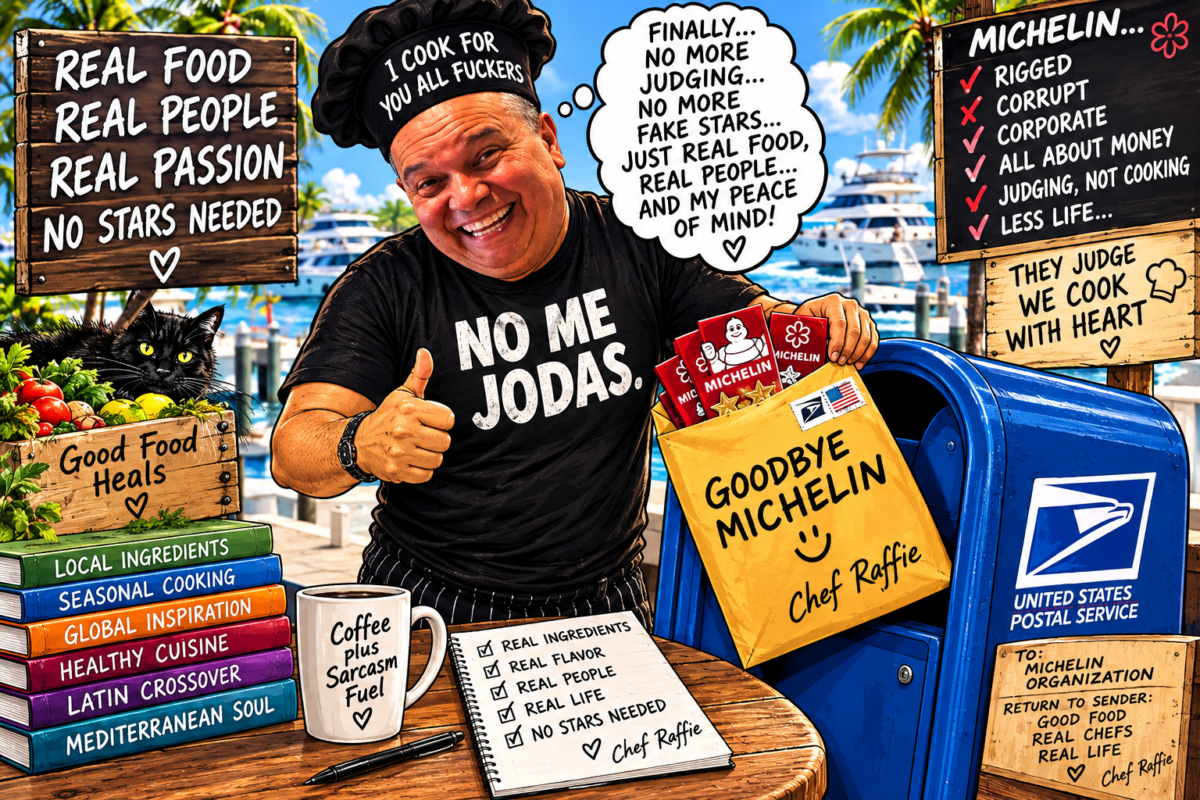
A chef who has sacrificed his health, his family, and his peace of mind for a star that may not even mean what it once meant.
And for what?
Who is judging us?
Who are we cooking for?
And who is educating the public to appreciate the food and wine we are working so hard to produce?
When the pursuit of excellence destroys the person delivering it, something has gone terribly wrong.
A chef is not a machine.
Give him the right conditions, proper rest, a functional galley, enough hands, and a respectful crew. Then watch what he can do.
Because real culinary excellence does not come from a five-gallon bucket.
It comes from knowledge, discipline, passion, ingredients, teamwork, and a little bit of madness.
The good kind of madness.
The kind that makes you wake up at four in the morning thinking about a sauce.
The kind that makes you travel across the world to find the perfect ingredient.
The kind that makes you cook for people because you genuinely want them to feel good.
That is what food is about.
Food is about happiness, life, emotions and long lasting memories.
And if we forget that, we have already lost the plot.
To all the chefs gradually being substituted by the stew cook,
I wish you: A spacious, functional and safe galley.
A patient and compassionate crew. Respectful guests.
An owner who understands that a chef is a human being.
And enough rest to remember why you started cooking in the first place.
May your sauces be from scratch, your ingredients be seasonal, your freezers be large, and your Michelin stars be optional.
Because at the end of the day, my friends, the greatest award is not the star on the wall.
It is the smile on someone’s face when they take a bite and say:
“Chef, this reminds me of home.”
Now that’s fine dining and no delivery truck can manufacture that.
Cooking Was The Easy Part.
Chef Raffie
#Yachting #YachtChef #SuperyachtChef #ChefLife #ChefLifeStyle #YachtLife #YachtingLife #YachtingIndustry #Superyacht #Superyachts #FineDining #FineDiningChef #MichelinStar #MichelinGuide #Gastronomy #CulinaryArts #CulinaryExcellence #FoodCulture #RealFood #CookingFromScratch #ChefCulture #ProfessionalChef #ChefLife #GalleyLife #YachtCrew #YachtCrewLife #CrewLife #YachtIndustry #YachtingCulture #TheFlyingFish