An Open Letter to Restaurant Chefs

By Chef Raffie. #26/0040.

An Open Letter to Restaurant Chefs Who Think Yachting Is Easy

Dear Restaurant Chef,

I’ve seen your Instagram.

Beautiful plates.
Microgreens placed with surgical tweezers.
Sauces swirled with the confidence of someone who has a dishwasher, a pastry chef, and a prep cook hiding just off camera.

Bravo.

Now allow me to introduce you to the luxury wellness retreat known as the superyacht galley.

A place where culinary dreams meet marine engineering, sleep deprivation, and the opinion of people who can’t tell the difference between cilantro and parsley.

First, your brigade disappears

Remember your brigade?

Your sous chef.
Your pastry chef.
Your prep cook.
Your dishwasher.

They’re gone.

Not on break.

Not late.

Gone.

On a yacht, you are now:

Chef
Sous chef
Pastry chef
Baker
Butcher
Fishmonger
Nutritionist
Purchasing department
Inventory control
Dishwasher
Sanitation officer

All inside a galley roughly the size of a walk-in closet with anger issues.

And the floor moves Constantly.

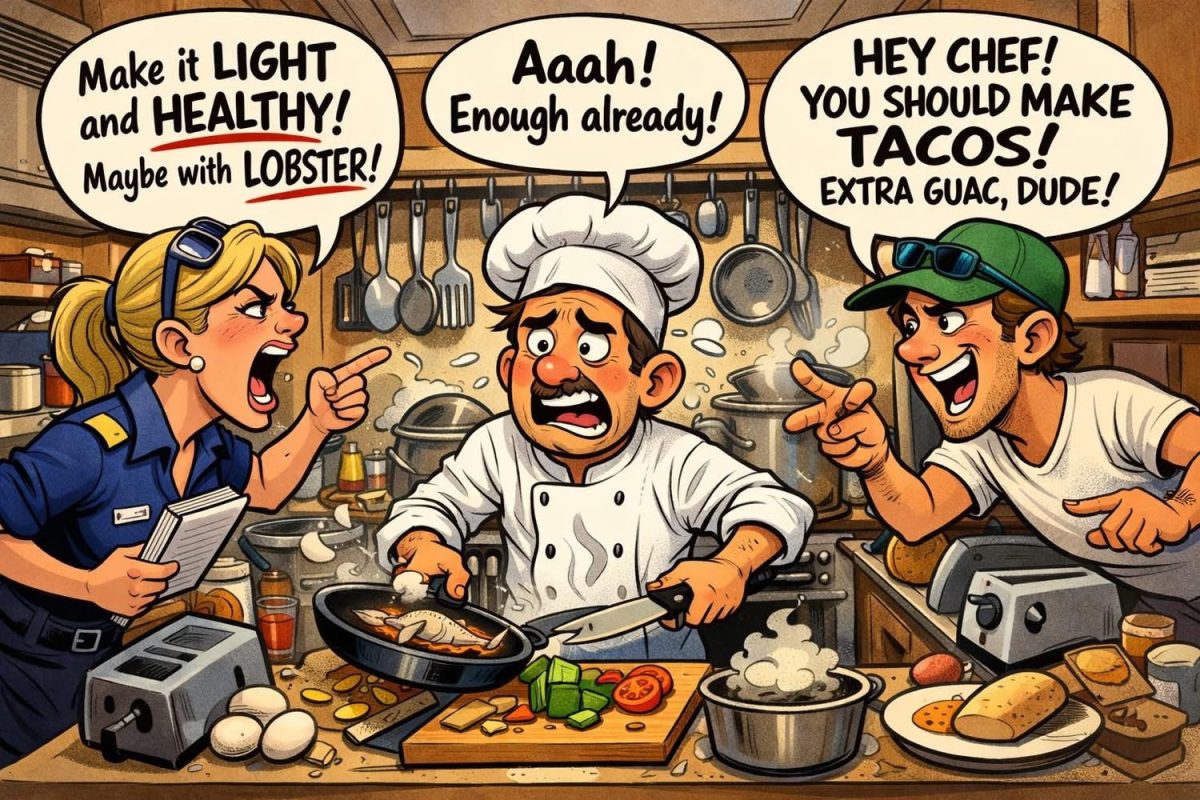
Enter the Chief Stewardess: Director of Global Culinary Strategy

Now the real magic begins.

The Chief Stewardess walks into the galley.

Three months ago she was selling scented candles at a duty-free shop in Gatwick or was a bartender in a dive bar somewhere in the hood.

But after watching half a season of Top Chef, she is now Vice President of Guest Culinary Expectations.

And God forbid you get a weekend off as a compassionate gesture from the owner for working 90 days straight without days off! Rest assured that on your return you’ll find the galley totally rearrange by guess who? The chief stew because according to her nothing can’t be found in the right place!

She says:

“Chef… the guests want something light tonight.”

You ask what “light” means.

She answers:

“Maybe lobster… but like… healthy.”

Ah yes.

The legendary keto detox paleo lobster cleanse.

A cornerstone of modern nutrition.
But what she’s really telling you is that she is the one who wants the F&@5$3 lobster

The Deckhand Culinary Consultant

Just when you recover from the lobster conversation, a deckhand appears.

He has been polishing stainless steel for six hours and is therefore spiritually prepared to offer culinary guidance.

He leans into the galley and says:

“Chef… have you thought about tacos?”

Thank you, Professor.

Thirty years cooking in three continents and I never considered tacos.

The entire culinary world will hear about this breakthrough.

Then comes the Captain.

The Captain recently watched a YouTube video titled:

“5 Easy Michelin Star Tricks Anyone Can Do At Home.”

So naturally he stops by the galley to say:

“Chef, I saw this guy reverse-searing a steak with a blowtorch… maybe we try that tonight?”

Of course, Captain.

Let me just blowtorch a Wagyu ribeye while the boat is rolling like a drunken metronome.

What could possibly go wrong?

The Guest Diet Matrix

Dinner preferences arrive.

Guest #1: vegan
Guest #2: gluten-free
Guest #3: keto
Guest #4: “vegan except seafood”
Guest #5: allergic to garlic
Guest #6: allergic to onions
Guest #7: doesn’t like fish that tastes like fish
Guest #8: only eats organic food flown from Italy

But remember…

“Keep it simple, Chef.”

Meanwhile… crew food

While preparing a seven-course tasting menu…

you also cook for 10 crew.

And crew are the most honest critics in gastronomy.

A deckhand will taste your food while smearing his arroz con pollo with ketchup and say:

“Chef… the chicken is a bit dry.”

Thank you, Anthony Bourdain of the swim platform.

Your critique has been noted and forwarded to the International Bureau of Poultry Moisture Control.

Provisioning reality

Restaurant chefs call a supplier.
Yacht chefs call three islands, two fishermen, and a guy named Miguel with a cooler.

Half the ingredients arrive.
The other half are “coming tomorrow”.
Tomorrow means maybe Thursday.
Thursday means God knows.

Midnight service
Finally, the day ends.
You clean the galley.
You lie down.
You close your eyes.
Then the radio crackles:

“Chef… guest cabin two would like a grilled cheese.”

At 2:13 am.

Because obviously the pinnacle of maritime luxury is nocturnal grilled dairy sandwiches.

The truth nobody tells restaurant chefs

Restaurant kitchens measure technique.

Yacht kitchens measure sanity.

Technique is important.

But try plating scallops while the boat is pitching 15 degrees and the Chief Stew is asking if the foam can be replaced by a lighter sauce!

That, my friend, is advanced gastronomy.

Final thoughts

So yes, dear restaurant chef.

Working on a yacht is incredibly easy.

All you need is:

  • culinary mastery
  • mechanical balance
  • psychological resilience
  • insomnia tolerance
  • and the ability to smile politely when the deckhand suggests tacos again.

Nothing complicated.

Just another day in paradise.

Signed,

A Yacht Chef Who Finally Understands Why Pirates Drank So Much Rum.

A Friendly Reminder…

#26/0027. By Chef Raffie.

A Friendly Reminder to Land-Based Chefs Thinking About “Going Yachting”

Every summer the same story begins again, around this time the same migration begins.
Restaurant chefs see a few Instagram chefs start posting sunsets.
Influencers show lobster Thermidor, wagyu sliders on the sundeck and stewardesses pouring champagne in slow motion.

Crew agencies promise “amazing opportunities.”
And suddenly half the restaurant industry thinks yachting is a floating Michelin restaurant with dolphins.

So allow an old galley pirate (32 years in the industry) to offer a small reality check before you pack your knives.

First, a technical detail many “job offers” seem to forget.

According to MLC regulations, vessels over 500GT and/or with more than 10 crew must have a certified Ship’s Cook responsible for crew meals.
So when you see offers like:
50m yacht
Solo chef
14 crew
12 guests or
50m yacht
Solo chef
11 crew
12 guests

That’s not a job.
That’s a psychological experiment and a cry for help disguise as employment.

If the crew including you is 10+, politely decline and remind them you follow MLC rules. If they want to hire an army of Generation Z interior crew while one chef feeds the entire NATO fleet, that’s their business — not yours.
“But the industry is booming!”

Yes… and no.

Mega yachts over 100m are indeed being built every year. Shipyards in Holland are busy, bookings are strong, and billionaires are still ordering floating palaces that look like apartments buildings with propellers. But here’s the detail nobody mentions

But for every 100m yacht, there are 50 boats under 40m — and that’s where most crew actually work.
And that’s where the circus begins.

Captains with management skills roughly equivalent to a nightclub bouncer and leadership expertise of a parking attendant.

Owners who can afford the yacht purchase, but not the yacht operation.
Management companies run by people who have never lived on board a vessel but somehow control every decision from an office chair. They monitor the budget like the Spanish Inquisition….

Things the Instagram posts will never tell you

They don’t tell you:

  • The owner basically lives on board six months a year.
  • The boat is chartering back-to-back while pretending it’s “private.”
  • The yacht goes into maintenance exactly when the guests arrive.
  • The captain’s girlfriend mysteriously becomes Chief Stew / Warden of the Interior Department.
    She could be the Captain’s girlfriend or wife.
    Which means the interior department is now run like a maximum-security correctional facility with champagne glasses, where smiling incorrectly during service is considered a disciplinary offense.

The Tip Cookie Jar

Ah yes… the famous charter tips.
Sometimes the management company holds them until the end of the season just in case you go crazy or reach a point of critical exhaustion and decide to jump ship in the middle of the season.
Sometimes they “adjust” them.
Sometimes they disappear into what I like to call:
The Bermuda Triangle of Accounting.

Strangely enough, the money always vanishes somewhere between the broker, management company, and “administrative processing.”

The Freelance Circus
Because many owners don’t actually want to pay full-time crew anymore, a new phenomenon has appeared:

The Freelance Economy of Yachting.

Freelance chefs.
Freelance chief stews.
Freelance engineers.

Why?

Because owners love the idea of having a yacht without paying for it when it’s not being used and because the yacht must exist for Instagram and the payroll must apparently be run like a budget hostel.

And then come the snake oil salesmen…
Now we have courses promising:

“Become a Yacht Chef in 5 weeks!”
“Earn six figures at sea tax free!”
“Live the dream!”

Apparently all you need is:

  • A chef jacket
  • A certificate
  • And a strong Wi-Fi signal for your Instagram.

What they don’t tell you is that cooking on a yacht means:

Cooking in a galley the size of a walk-in closet
Provisioning like a logistics officer in a war zone
And plating Michelin-level food while the boat rolls like a washing machine.

Final Advice from an Old Galley Pirate

Yachting can be amazing.

You’ll see the world.
You’ll meet fascinating people.
You’ll cook incredible food.

But remember this:
What you see on Instagram is marketing.
What you experience onboard is reality.
And those two things…
are often very different oceans.
So before you accept that “solo chef for 14 crew and 12 guests” position…
take a deep breath…
read the contract…
and remember:
Sometimes the real luxury in yachting is simply having enough crew to survive the season.

Fair winds, young chefs.

And read the contract before you pack your knives.
I wish everybody a great weekend!

Chef Raffie

The Great Floating Illusion of Modern Yachting


By Chef Raffie. #26/0022.

The Great Floating Illusion of Modern Yachting

A small observation from the galley window

Somewhere along the way, yachting stopped being about the sea… and became about the marina parking lot and a virtual lifestyle.

You can see it clearly in Florida.

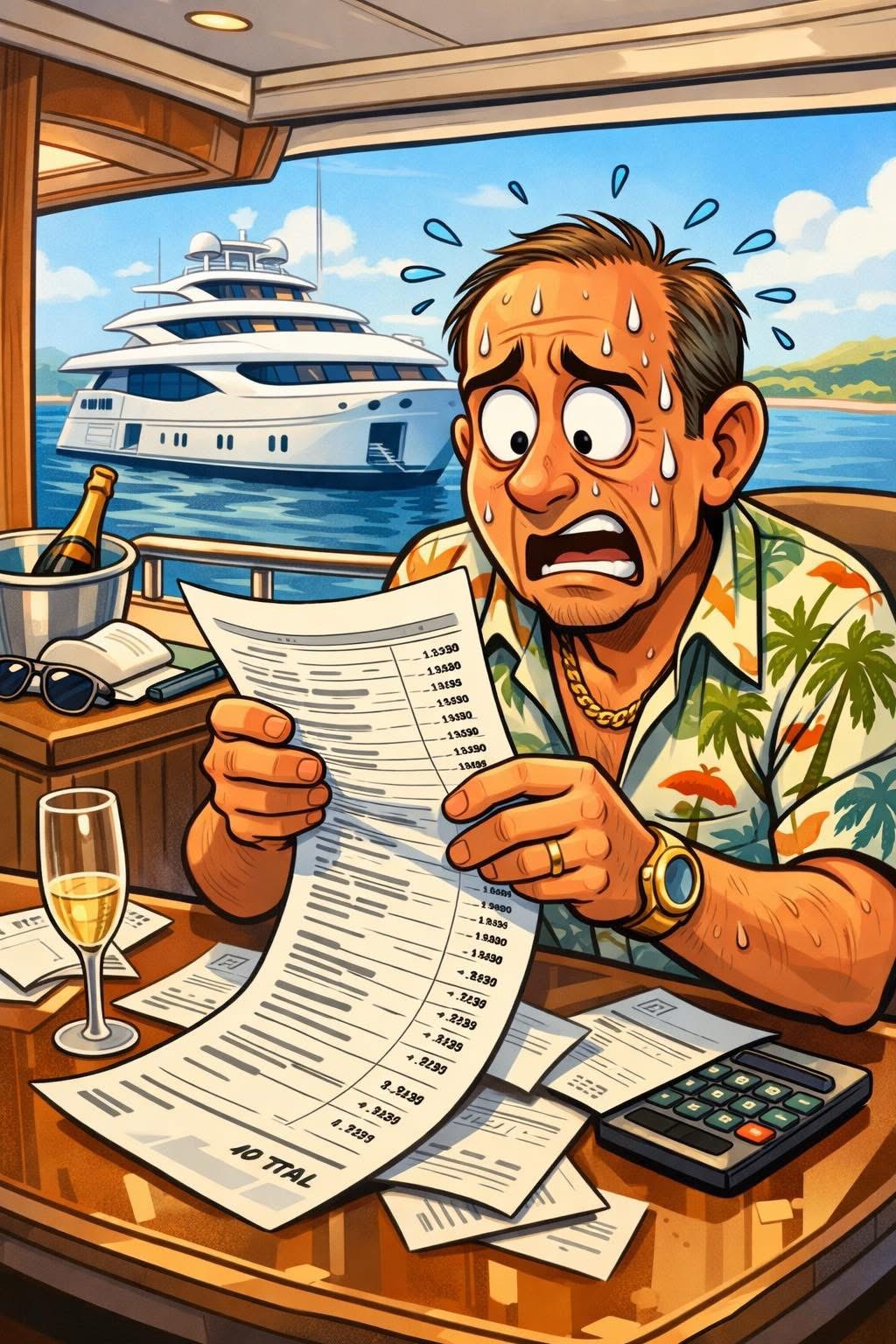
A parade of floating palaces arrives every season. Glossy hulls. Drone footage. Champagne on the bow. A broker whispering sweet financial poetry into the ear of a freshly minted yacht owner who just sold three tech companies and believes Poseidon personally approved the purchase.

“Sir… this vessel is an investment in lifestyle.”

Translation:
Congratulations, you just bought a very expensive hole in the ocean that eats money faster than a morbidly obese human at an all-you-can-eat buffet.

But the real comedy begins after the papers are signed.

Because no one told the owner the small print:

The yacht costs money.
Running the yacht costs more money.
Running it properly costs real money.

And suddenly the budget meeting begins.

Strangely, there is always money for:

  • A new Seabob
  • Underwater lights visible from space
  • A teak deck polished by monks from the Himalayas
  • Twelve cases of rosé for Instagram

But when it comes to the crew?

Silence!

Deck shoes?
“Do you really need those?”

Crew food budget?
“Does the owner has to feed the crew”

Safety gear?
“Isn’t the ocean already safe?”

Medical insurance?
“Well… try not to get injured.”

Meanwhile the yacht broker — the same man who sold the dream — is already three marinas away selling another “once-in-a-lifetime opportunity” to someone else.

A modern version of a snake oil salesman, except the wagon is now a 40-meter fiberglass miracle financed over fifteen years.

And let’s talk about these boats for a moment.

Because some of them…

My friends…

Some of them are built with the structural integrity of an IKEA wardrobe closet .

Aluminum, plywood, fiberglass, and optimism.

Yet somehow the price tag suggests it was handcrafted by Renaissance shipbuilders blessed by Neptune himself.

But the greatest masterpiece of the modern yacht industry is not the boat.

It’s the illusion of responsibility.

Owners are never involved.

Never.

They exist in a mysterious cloud of plausible deniability.

Crew problems?
“Management handles that.”

Budget cuts?
“Talk to the captain.”

Safety concerns?
“Send an email.”

Yet somehow instructions travel across the Atlantic at the speed of light when the topic is:

“Reduce crew costs.”

Amazing phenomenon.

NASA should study it.

And the loyalty question?

Ah yes, “Loyalty “

The industry once ran on reputation.

Now it runs on WhatsApp availability.

Two years of service.
Storms. Deliveries. Owner trips. Sleepless charters.

But then…

The captain’s golf buddy needs a job.

And suddenly you discover loyalty in yachting now has the shelf life of supermarket sushi.

Gone.

Replaced before the coffee gets cold.

Meanwhile in the marina the show continues.

Owners posing on the bow.
Influencers filming sunsets and glorious displays of buffets elaborated with premade store bought ingredients.
Brokers telling stories about “the lifestyle.”

Below deck the crew quietly calculates if the owner can afford fuel for the next crossing and the real food budget?

Sometimes the answer is no.

Which raises the most uncomfortable question in modern yachting:

Not who owns the yacht.

But

Who can actually afford it.

Because buying a yacht is easy.

Running one with integrity?

That’s where the fantasy sinks faster than a jet ski with a hole in it or a green stew after her 90 days trial period.

But don’t worry.

The photos will look fantastic on Instagram.

And in today’s yachting world…

That seems to be what really matters. 🚤💰

In search of a Michelin Monkey

By Chef Raffie. #25/1122.

The original post;

Hello,

On behalf of 28M Benetti I’m looking for qualified and hands on CHEF, who will rein in galley and will be able to provide exceptional meals, preferably Mediterranean cuisine.
Age- 50yo max,
Salary-4500$
Location-Cyprus.
All certificates in hand.
No visa restrictions for EU.
Send your CV and intro my way:
interior8877@gmail.com

My reply to a facebook post;

Good afternoon,

Thank you so much for the opportunity to apply for this prestigious position — cooking Mediterranean cuisine at the level of a Greek deity while simultaneously running the galley like Gordon Ramsay’s long-lost, calmer twin.

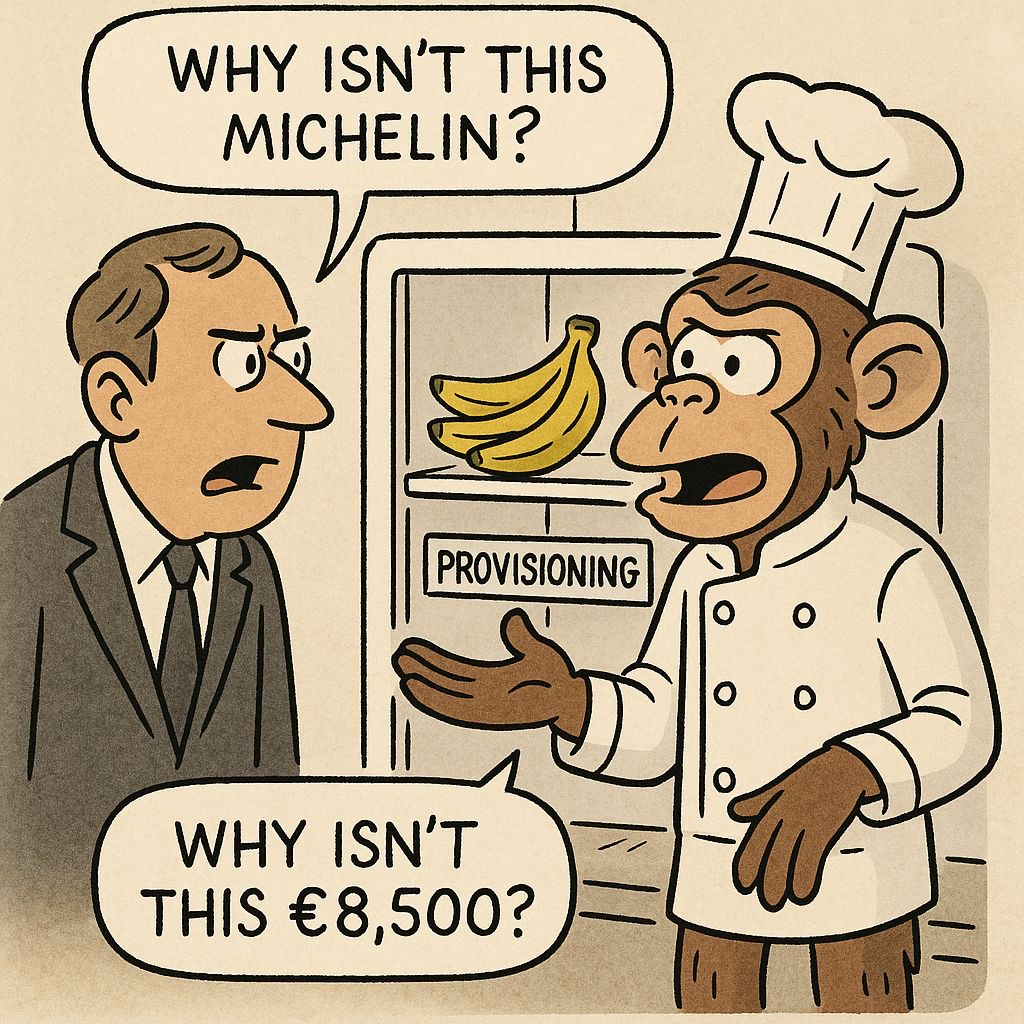
I must say, the €4,500 monthly salary offer for a “qualified, hands-on Rockstar Chef” in Europe is truly visionary. It takes real creativity to request Michelin-level execution, international certifications, EU-friendly paperwork, emotional stability (presumably), and the patience of a yoga instructor — all while offering a wage typically seen in… steward departments or perhaps very motivated monkeys in the wild.

As the old saying goes:
If you pay peanuts, don’t be surprised when the galley gets overrun by enthusiastic primates whipping up banana purée.

I truly appreciate ads like this — they remind me why good chefs suddenly “find Jesus” and become land-based, or mysteriously vanish to the Caribbean after reading preference sheets.

Wishing you the very best in your search for a unicorn who cooks like Alain Ducasse, costs like a deckhand, and apparently does not age past 50. What a world.

Warm regards,
Chef Raffie
But tragically over 50 in experience, taste level, and dignity.

The Gospel According to Jocelin: Patron Saint of Shiny Trash Cans

By Chef Raffie. #25/1104.

Disclaimer: Any resemblance to real yachts, real people, or real disasters is purely coincidental… though if you happen to recognize yourself, congratulations — you’ve officially inspired art.

The Gospel According to Jocelin: Patron Saint of Shiny Trash Cans

Some say she was 32. Others swore she looked 12. Either way, Jocelin Achieves, as she called herself, had mastered the ancient art of faking it until you steal a cutting board.

She claimed to have worked on 80m, 90m yachts — mega-yachts, darling — but couldn’t tell a port side from a pork chop. I asked her once how many liters in a gallon — she blinked twice, allergic to the question. (She’s allergic to everything, by the way. Except designer yoga pants and designer lies.)

Let’s be fair. Jocelin had many talents. Interviewing, for example. She interviewed better than a CIA double agent. She could convince you she invented lemon water. And if you questioned her, she’d just say: “It’s because I’m highly intuitive. And Scorpio.”

Amazon Prime Minister of Provisions

Now provisioning… ah yes… provisioning was her kingdom.

While I was trying to keep provisions realistic — you know, for a two-week boss trip with four kids and a golden doodle — Jocelin shopped as if she were preparing for Armageddon hosted at Burning Man.

“Two beach umbrellas?”

“No Chef, we need SIX. Three for the boat, three for my… I mean… for backup.”

Laundry detergent? Enough to outlive a nuclear war.

Deck shoes? Rotated quarterly like tires on a Ferrari — because nothing says “guest-ready” like new Sperrys every full moon.

Yeti coolers? “Let’s get two, in case one breaks. Or melts. Or floats away in a hurricane.”

And the best part? The extras always had a destination: her house. She said it was “in case we run out, we don’t need to re-provision — just swing by my place, I have a backup pantry.”

You mean… Costco Warehouse North, located at Casa Jocelin.

The Trash Can Heard Around the Dock

Let’s talk about that trash can. A $300 voice-activated robotic trash can that lit up like a spaceship when you approached it. It talked, opened with grace, and probably knew your zodiac sign.

It lasted two months.

Then Jocelin said: “It’s defective. We have to return it.”

The new one arrived. But the old one?

Last seen in Jocelin’s kitchen, housing “organic-only” waste and the dreams of honest yachties everywhere.

Same thing happened with my oak cutting board — three months of seasoning, oiling, bonding with it like it was my firstborn. One day she declared:

“Chef, it’s not visually appealing anymore. The Mrs. wants everything to look new.”

Guess where it went?

Yes. Her house. Next to my frying pan. And my soul.

Christmas Came Early… For Her Entire Family

During the holidays, the crew noticed something strange.

Jocelin was gifting brand new deck shoes to her family. Different sizes. Different colors.

“Wow! So thoughtful!” they said.

Yes, thoughtful indeed — straight from the boat’s Amazon orders, re-gifted with wrapping paper and guilt-free charm.

There were stories of provisioning miracles — snacks disappearing mid-charter only to reappear in her air-conditioned Tupperware closet. And that mystical gallon of almond milk that cost $30 — always one for the boat… and one for home, of course.

Let’s not forget the time she ordered eight brand-new pillows because “the old ones absorbed too many negative emotions.” Naturally, the “used” ones found shelter in her guest bedroom. Sustainability, Jocelin-style.

In Jocelin We Store

She had a lifetime membership at The Container Store. I’m convinced she didn’t just shop there — she was stockpiling for the apocalypse.

We needed one cooler. She bought four.

A new mop? Why not two.

Sunscreen? Gallons.

Tampons? Costco crates.

And always, always… she said:

“Better to have it and not need it, than to need it and not have it.”

Unless it’s honesty. That, apparently, she could live without.

The Jocelin Effect

After a year, we realized something.

The boat always looked sparkling. Everything was new. She was always glowing… because her entire house was fully furnished courtesy of the yacht’s Amazon Prime wish list.

She didn’t just steal stuff.

She manifested it.

She didn’t just over-order.

She achieved it.

And when she left? She called it “graduating.”

We just called it relief.

Final Credits

So next time someone says “fake it till you make it,” just ask:

“You mean like Jocelin — the Patron Saint of Prime Deliveries, Trash Can Thief, and Cutting Board Collector of the Caribbean?”

Because she didn’t just fake it.

She made it sparkle.

And took it home.

The Galley Ghost

By Chef Raffie. #25/1097.

Disclaimer: This post is inspired by random nonsense I saw floating around on social media. Any resemblance to real-life situations, actual yachts, or Cleopatra-wannabe chefs is purely accidental… and totally coincidental… and also absolutely happening in real life.

Ahoy, family—let’s talk about “fine dining at sea.”

When you sign up for a small boat gig, you expect a bit of chaos. What you don’t expect is a chef who doesn’t cook.

I’m currently working on a 20-meter floating soap opera where the captain and the chef are a couple. Sounds romantic, right?

Wrong.

Because this particular chef… doesn’t cook.

At all.

Not when there are guests, not when there aren’t guests, not while we’re navigating, not while we’re parked in the marina, not on Mondays, not on Sundays, not with a fox, not in a box… Dr. Seuss would be proud.

She simply. does. not. cook.

The only time I’ve had something resembling a decent meal since joining this floating sitcom was when the owner came aboard. He decreed, like Poseidon himself:

“We shall all dine together.”

And lo and behold, she materialized in the galley—pots clanging, apron on, fulfilling her long-forgotten role as “chef.”

The second the boss stepped off? Puff! Gone. Like Cinderella at midnight—back to the pumpkin.

Meanwhile, the crew survives on scraps, half-hearted snacks, and the spiritual nourishment of despair.

I tried raising it with the captain (who, in case you missed it, happens to be her partner). But love, as they say, is blind—apparently also deaf, mute, and tastebudless.

He won’t lift a finger.

Why This Matters

You might be laughing—and you should, because the absurdity writes itself—but here’s the truth: this isn’t just a funny crew tale. It’s a red flag for crew welfare and, eventually, for the owner himself.

A yacht with a chef who refuses to cook is like a Ferrari with no engine: pretty on the outside, useless on the inside.

Crew morale tanks.

Health suffers.

Service crumbles.

And sooner or later, even the most patient owner will realize something’s rotten—not in Denmark, but right in his own galley.

So no, this isn’t mockery. It’s awareness.

Because food on board isn’t just calories—it’s culture, morale, and sanity.

And a boat without it? That’s not yachting, my friends.

That’s slow torture on the high seas.

The Queen of Not-Cooking

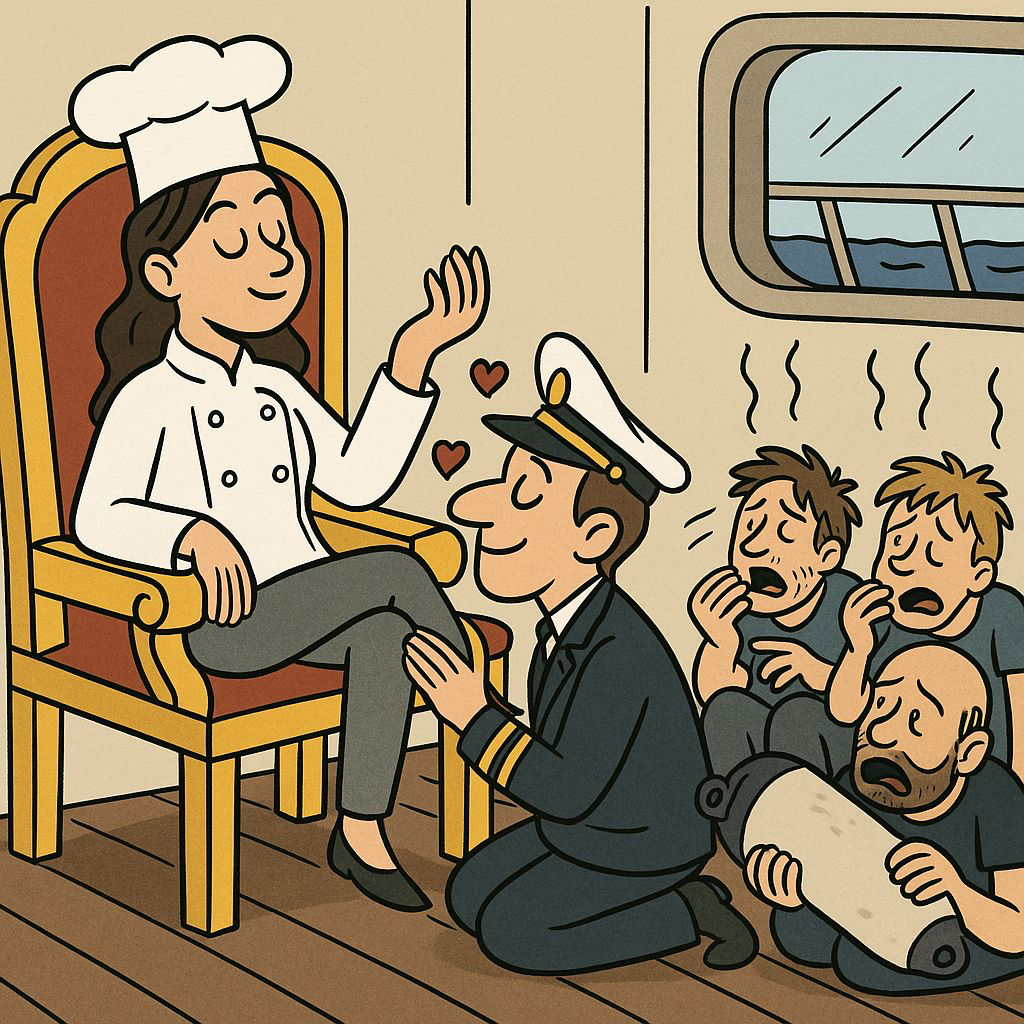
There she is—sitting on her throne like Cleopatra of the Caribbean, admiring her manicure while the captain worships her as if she just invented bread… and the crew starves quietly on the floor.

Because really, what’s the point of having a chef on board?

Cooking is so overrated. Better to have pretty nails and a boyfriend who covers up the chaos.

Meanwhile, the poor deckhands are chewing on fenders like they’re artisanal baguettes.

Bon appétit, mes amis.

Final Thought

This isn’t about mocking individuals—it’s about calling out a real issue.

A boat without food is a boat without soul.

Crew depends on the chef just as much as on the captain, and when that role collapses, the entire operation starts to rot from within.

Sooner or later, even the owner will taste it.

The Great Mediterranean Circus of Yachting

By Chef Luis Rafael Hurtado. #25/1086.

Ladies and gentlemen, children of all ages, welcome to the Mediterranean — the greatest circus afloat.

Not the Cirque du Soleil, mind you, but a clown show where the ringmasters are captains with PTSD, the brokers are snake-oil salesmen, and the audience is an owner who thought buying a 50-meter yacht was the same as adding a pool to the backyard.

Let’s start with the brokers, shall we? These magicians in polo shirts and fake tans sell yachts like used cars, conveniently forgetting to mention that owning a yacht is not like buying a condo in Monaco.

Surprise. It’s a floating business — with engines, hydraulics, and twenty exhausted humans that require food, sleep, and a salary that doesn’t resemble an insult. But no, they whisper sweet nothings to the owner:

“You’ll host glamorous parties, eat Michelin-star dinners, and sail into sunsets.”

They forget to add:

“…on the back of an unpaid, underfed, underslept crew who will eventually plot your murder with a butter knife.”

Then come the owners. Some lovely. Some absolutely clueless.

Owning a yacht does not mean you know how to run one.

You wouldn’t buy a hospital and then try to perform open-heart surgery, but somehow, you think running a vessel with international regulations, visas, and safety codes is easier than programming a microwave.

And when things go wrong (and they always do), the first people blamed are not the brokers who lied, but the poor crew trying to MacGyver miracles out of duct tape, prayer, and broken promises.

Crew rest? Please.

Rest is treated like a mythical creature — something you read about in books but never see in real life.

God forbid a crew member takes a nap.

The owner might think they’re lazy, when in reality, they’ve been awake for twenty hours making your foie gras foam while also unclogging your toilet.

Now let’s talk salaries and day rates.

Somewhere along the line, the industry decided to normalize peasant wages for highly skilled professionals.

Chefs are expected to plate like Alain Ducasse on a Taco Bell budget.

Engineers are supposed to rebuild engines overnight with chewing gum and zip ties.

Stews have to smile through abuse while folding your underwear into origami swans.

And the cherry on top? Exposure.

Exposure doesn’t pay rent, Karen.

So yes, the Med has become the ultimate floating disaster.

Harassment, burnout, contracts treated like confetti, crew stranded in random ports with no pay, captains imploding, owners exploding.

The whole circus is alive and well.

But here’s the plot twist: it doesn’t have to be this way.

This industry can be extraordinary when people respect it.

When brokers tell owners the truth.

When owners understand that running a yacht is not a hobby, but a responsibility.

When management companies prioritize human beings over invoices.

When crew are given rest, proper food, and the dignity they deserve.

Because beneath the sarcasm, there’s still love for the sea, for the adventure, for the camaraderie that keeps us here despite the madness.

If we start holding people accountable, demanding better standards, and treating each other like professionals — not circus clowns — then maybe, just maybe, we’ll stop juggling chaos and start sailing into the future we all deserve.

Until then, keep your helmets, life jackets, and sense of humor close at hand.

A Burnt Out Memoir

Yachting Culture #25/1062.

“So Let Me Get This Straight…”

A Burnt-End Memoir in Real Time by Yours Truly Chef Raffie

So let me get this straight…

I just landed in Nice—a land known for rosé, regrets, and rejected provisioning invoices—when my WhatsApp lit up like a fryer fire:

“No money.”

“Guests arriving tomorrow.”

“No groceries.”

“Apartment cooking too?”

“Also we need lunch in 2 hours. Can you do gluten-free sushi? But also vegan. But also caviar.”

I am tired. I am hungry. I am already mildly regretting all my life choices.

How did I go from “chef” to underpaid culinary therapist with a side hustle in miracles?

I haven’t even seen the galley yet and I’m already expected to prep lunch, dinner, and somehow manifest a five-course welcome dinner—with no provisions, no budget, and no time.

Oh, and for the record? The last two chefs apparently escaped into the sunset, burned out, used up, and (if there’s any justice in this world) now running a taco stand in Bali.

When I finally step into the galley, it hits me.

I’m not entering a kitchen.

I’m entering a crime scene.

The place is wrecked.

The onions are half-chopped and crying harder than I am.

There’s a smell that can only be described as culinary PTSD.

There’s no petty cash. No provisioning card. No plan. No clue.

But somehow I’m the one expected to whip out soufflés, sushi rolls, and foie gras foam like I’m auditioning for Hell’s Kitchen: Yacht Edition.

And the cherry on top?

“Can you smile more?”

“Hospitality is the heart of yachting.”

Excuse me—what?

Hospitality? You mean pretending everything’s fine while crafting fine dining from an empty fridge, a wet sponge, and a stewardess asking if I’ve ‘started plating yet’?

And God forbid I ask for one day to prep.

One. Freaking. Day.

A single moment to breathe.

To clean up the galley battlefield.

To locate something that isn’t expired or suspiciously green.

To plan a menu with actual ingredients instead of summoning lunch from the ether like a culinary necromancer.

But no.

Apparently, asking for a prep day is a diva move.

I’m not here to cook—I’m here to perform miracles.

So here I stand:

Eye twitching.

Hands trembling.

Holding a can of energy drink in one hand and an empty packet of vegan cheese in the other.

And quietly asking myself:

“Do I cry now or wait until service?”

💡 

The Moment of Clarity

I didn’t scream.

I didn’t throw a ramekin.

I didn’t set the galley on fire and fake my own death (…tempting though).

Instead, I took a deep breath, wrote this story in my head, and realized:

  • A day to prep isn’t diva behavior. It’s basic fing logistics*.
  • Communication isn’t a luxury. It’s the difference between Michelin stars and meltdown scars.
  • And most importantly: I’m a chef, not a one-man cruise ship food court.

🙌 Final Thoughts for My Fellow Galley Gladiators

You are not crazy.

You are not failing.

You are not ungrateful.

The industry is just drunk on its own delusions and expecting us to clean up the mess without even handing us a mop.

So if you’re feeling the pressure…

If you’re holding back the scream…

If someone just handed you a lemon and asked for a tasting menu—

I see you. You’re not alone.

Now go pour yourself a glass of wine. Or a triple espresso.

Or whatever keeps you from throwing the immersion blender at someone.

Because if Jesus could feed 5,000 with five loaves and two fish…

You can politely tell them you need a fing provisioning day.*

Have a wonderful, productive, and stress-free weekend.

(And if not, at least document it—there’s a book in this somewhere.)

Season‘s End

Yachting Culture #25/1057.

Season’s End: A Message from the Galley

By Chef Raffie

I’m Tired. I’m Exhausted. I’m Still Here.

To every crew member, chef, stew, deckhand, and soul barely holding on—

Right now, I’m standing somewhere between faith and fatigue.

My body aches. My heart is heavy. My future feels uncertain.

But I still have God. I still have hope.

And I’m finally saying this out loud:

I am not okay. And that’s okay.

This industry has a way of breaking you down quietly.

You give everything—your sleep, your health, your sanity—

All for someone else’s luxury holiday, or that perfect Instagram plate.

And when you’re hurting, the response is always the same:

“Push through.”

“Tough it out.”

“Take a shot and keep going.”

I’ve done that. For years.

But now I know better:

There is no medal for dying with your clogs on.

To every chef hiding pain behind a smile,

To every stew faking energy in the laundry room,

To every deckhand swallowing exhaustion just to avoid being replaced—

You are not weak. You are human.

🛳️ To captains, owners, brokers:

If you’re going to call us “family,” then protect us like one.

That means real support—therapy, time off, grace—not just bonuses.

🙏 To everyone in this industry:

If you’re breaking, speak.

If you’re tired, rest.

If you’re drowning, ask for help.

Before it’s too late.

I’m choosing healing. Choosing honesty.

Choosing not to become another silent statistic.

And if you’re reading this?

You can, too.

God, have mercy on those who serve.

And may we all remember:

We are worthy of being served, too.

The season is almost over. Hold on.

—Chef Raffie

#YachtingMentalHealth #HospitalityBurnout #ChefLife #CrewCare #ItsOkayToNotBeOkay #FaithOverFatigue #AskForHelp #NotAnotherStatistic #HealingIsCourage

The Chief Stew Chronicles

The Chief Stew Chronicles: Tales from the Espresso-Fueled Twilight Zone by Luis Rafael Hurtado. #25/1018.

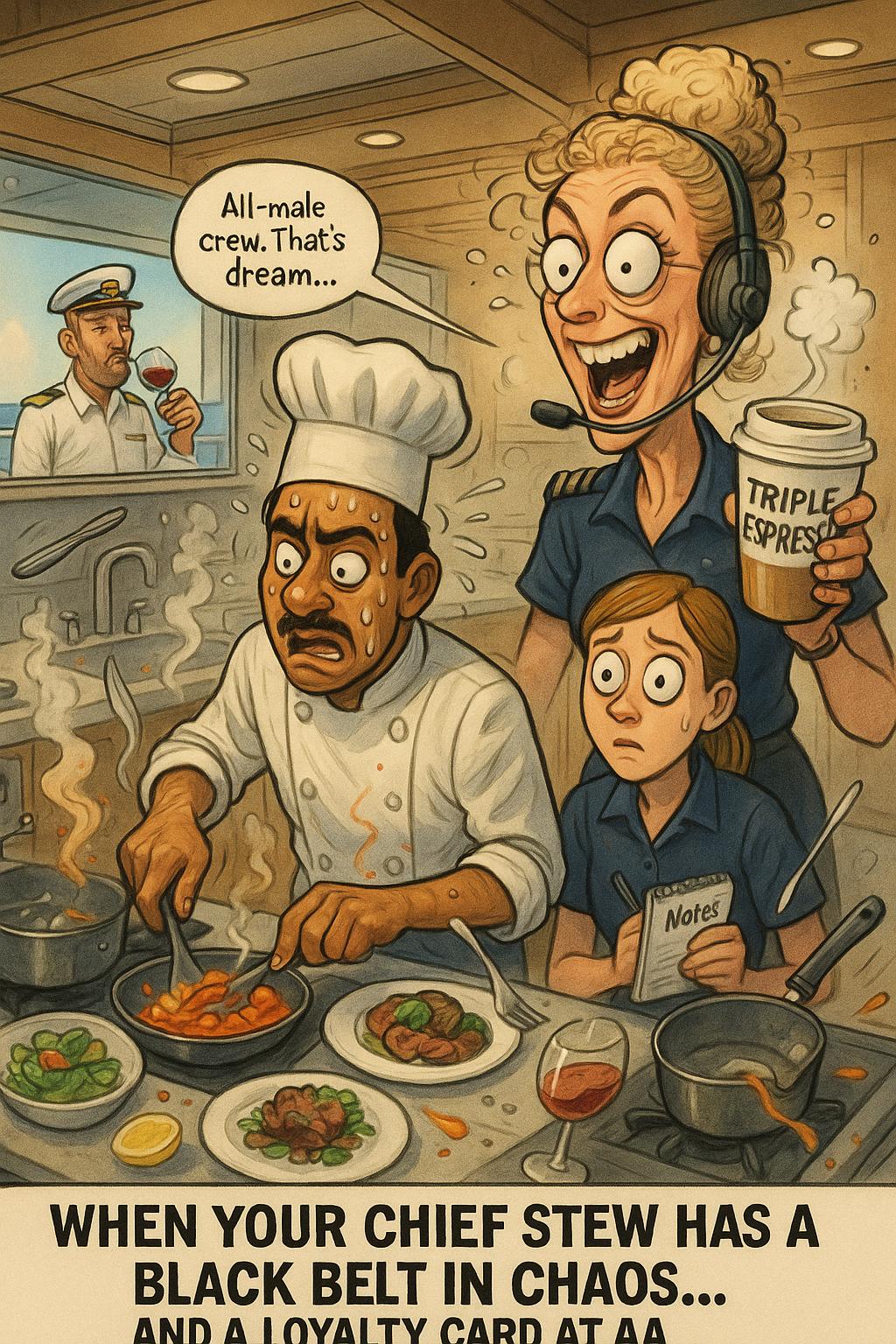
Once upon a time—because every nightmare deserves a fairy tale intro—I found myself trapped aboard a floating asylum disguised as a yacht. And at the helm of chaos, ruling the roost with a steely blow-dried grip and a latte in hand, was our beloved Chief Stewardess: a walking, talking cautionary tale in yacht whites.

Now, don’t get me wrong—on paper, she was a “great stew.” Five-star service, polished cutlery, candles lit with military precision. But behind the scenes? Oh darling, she made a root canal look like a spa day.

This woman did not speak—she narrated her entire stream of consciousness aloud, like an audiobook nobody asked for. She had conversations with herself, with the vacuum, with the spoon drawer, and occasionally, she even included us lowly crew mortals—though she’d interrupt us before we could respond. Asking a question, then cutting me off halfway through my answer? Iconic.

Fueled by six shots of espresso and unresolved childhood trauma, she zipped around the boat micromanaging like it was an Olympic sport. If dinner was scheduled for 8pm, she’d be in my galley at 6:43pm, sweating bullets over a napkin fold, while I’m elbow-deep in mise en place.

“Do you need help?”

No. I need space. And maybe divine intervention.

Forget chilling—she had no off switch. She’d wake up from a nap she somehow had time for (unlike the rest of us) and immediately jump back into talking about dinner service seven hours away. Meanwhile, I’m still trying to get through breakfast without burning the eggs or my will to live.

But the pièce de résistance? The after-hours “team bonding” events. You know, the ones she orchestrated like a cruise director on meth. She’d gather the crew, pour the rosé, and proceed to get delightfully smashed while drama unfolded faster than a Real Housewives reunion.

Nothing says relaxation like watching your Chief Stew weep over her third vodka soda and accuse the deckhand of stealing her soul.

And let’s not forget her poor Second Stew, who followed her around like a baby duck imprinting on a hair-straightened hurricane. You could see the life force slowly drain from that girl’s eyes by Day 3.

The Captain? Oh, he was fully aware. He even joked—half-serious, half-desperate—that life would be better if we were all male crew. (Same energy as “Men’s Mental Health Month,” but with less emotional intelligence.)

Look, it wasn’t just that she was annoying. It was that she made what could’ve been a straightforward, professional, and even enjoyable job feel like psychological warfare. Working alongside her didn’t feel like teamwork—it felt like surviving a hostage situation with high-thread-count sheets.


Compassionate Coda

In her defense—and yes, there’s always a dark little asterisk to these stories—she was a survivor of something far bigger than this industry. Years of alcoholism and drug addiction had rewired her emotional landscape, replacing calm with control and connection with chaos. Stability didn’t come easy to her; she compensated with over-functioning and manic leadership, probably afraid that if she let go for even one second, everything would collapse—including herself.

So I see her. Behind the mascara, behind the monologue, behind the micromanaging—there was a wounded woman doing her best not to drown in her own unfinished healing.

But Lord help us all…

she made sure we all got a taste of the whirlpool.